
Gutter Guards in Chino Valley, AZ
On an open grassland basin, debris does not fall into a gutter — it is driven in sideways. We fit micro-mesh sealed at the roof edge and mechanically fixed, on houses and outbuildings alike.
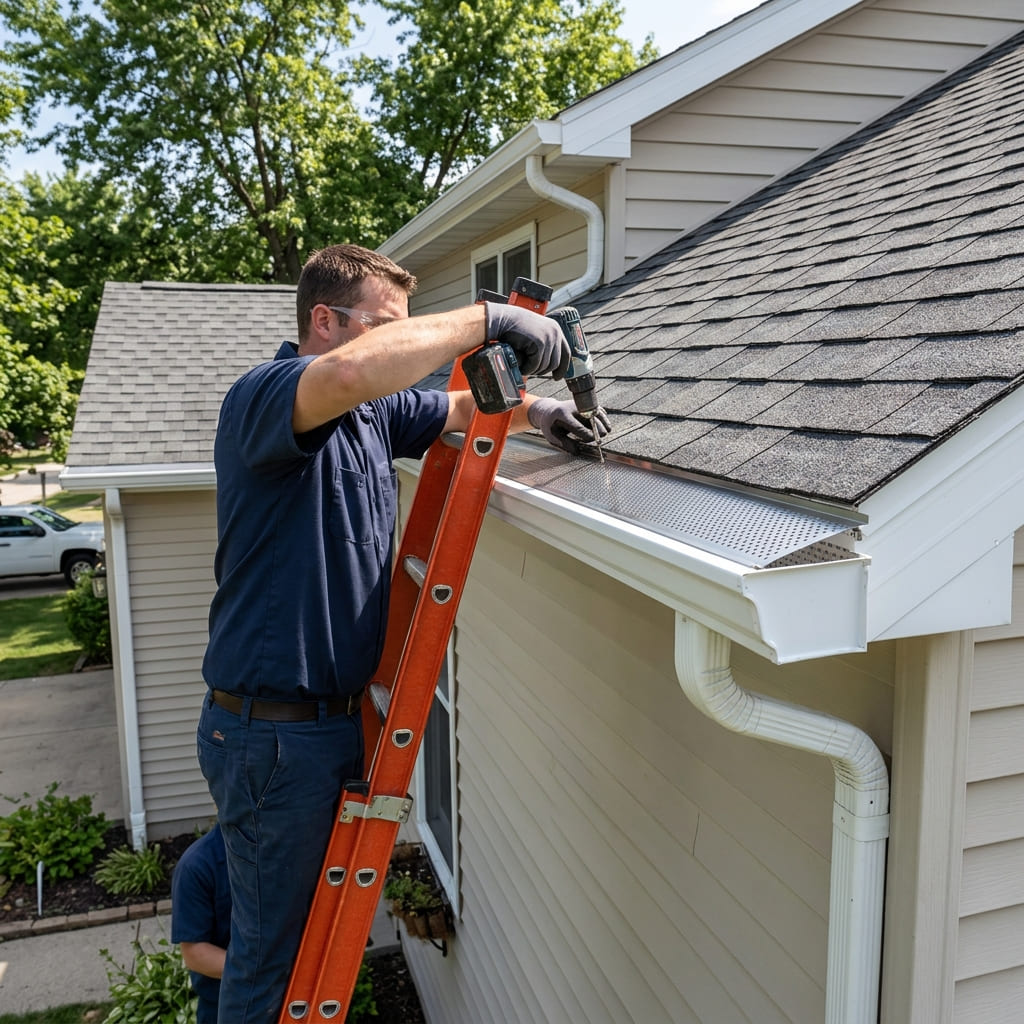
Gutter Guards for Chino Valley homes.
Chino Valley sits at roughly 4,750 feet in an open semidesert grassland basin with very little to break the wind, and that single fact changes what a gutter guard has to do here. In a sheltered market, debris falls into a gutter from above and a guard’s job is to cover the opening. In this basin a great deal of what ends up in your gutters arrives horizontally, driven along the roofline rather than dropped onto it. These products are almost always advertised as leaf guards, and that name carries an assumption — that debris arrives by falling — which is precisely the assumption an open basin does not honour.
AZ Gutter Pros fits gutter guards across Chino Valley — the SR-89 corridor, the numbered road grid neighbourhoods, the Del Rio Springs area, out along Perkinsville Road, and on the outlying ranch and hobby-farm acreage.
A guard that only covers the gutter opening leaves a gap where the guard meets the roof edge, and wind-driven seed head, chaff, and alkaline dust go straight under it. The gutter fills anyway — and now there is a lid over the top so nobody notices until the first real storm sheets over the front edge. We fit guards that seal against the roof edge for that reason, and we fix them mechanically rather than relying on friction under the shingle course, because on an exposed lot a guard is also a surface the wind can get underneath. Our Chino Valley gutter services page covers what this basin’s wind and clay soil do to a system generally.
On a hobby farm or horse property, the barn and shop matter as much as the house. AZ Gutter Pros sizes each building to its actual roof area, quotes them separately so the work can be phased, and puts the whole thing in writing before anything starts.
What a Chino Valley guard job includes
What actually clogs gutters in Chino Valley.
What a gutter collects in an open basin, and what each load needs from a guard:
| What lands in the gutter | Where it comes from | What handles it |
|---|---|---|
| Grassland seed head, chaff & dust | Wind-carried across open ground — arrives horizontally | Micro-mesh sealed at the roof edge; a guard that only covers the opening lets it under |
| Fine juniper litter | Native stands along the basin edges | Stainless micro-mesh |
| Blown soil & alkaline dust | Bare ground, worked land and unpaved county roads | Micro-mesh — it glazes over time and wants an occasional rinse |
| Snowmelt, arriving slowly | Roughly 13 inches of snow across an average winter | Guard pitched so slow meltwater enters rather than running past the front edge |
Wind changes what a guard has to do here.
Horizontal debris is the detail that most guard installations in this basin get wrong. Guards are generally designed and marketed around vertical loading — leaves and litter falling onto the mesh from a tree above. That is a fair description of most markets and a poor description of Chino Valley, where fine grassland seed and chaff travel on the wind and hit the roofline from the side.
The consequence is specific: the vulnerable point is not the mesh, it is the joint where the guard meets the roof edge. A product that simply sits over the gutter opening leaves that joint open, and wind-driven debris packs in behind it into the back of the run. This produces the worst version of a clogged gutter — one you have paid to prevent and can no longer see. We seal that edge as part of the fitting, and on properties with long, low outbuildings we pay more attention to it rather than less, because those roofs sit in more wind and get inspected far less often than the house does.
The second wind problem is the guard itself. Anything fitted along a roof edge on an exposed lot is a surface that air can get underneath, and a guard that lifts at one corner will work progressively loose along the run. On a metal outbuilding roof that stops being a maintenance issue and becomes a genuine hazard in a spring gale. We fix guards mechanically rather than relying on friction under the shingle course alone, and we check downspout strapping at the same visit, since a downspout strapped only at the top is the most common wind casualty on this basin.
Winter adds a quieter requirement. Chino Valley collects around 13 inches of snow in an average year, and meltwater behaves differently from rain — it arrives slowly and repeatedly rather than in a burst. A guard pitched slightly wrong sheds a hard rain adequately but lets slow meltwater run past the front edge instead of taking it in, which puts water directly onto ground that this basin’s alkaline clay will not absorb. That is the same problem the downspout and drainage work here is built to solve, so we check the two together rather than separately.

Gutter Guards cost in Chino Valley.
Guards are priced per linear foot. In this basin the fitting detail — sealing at the roof edge and mechanical fixing — matters as much as the mesh, and it is included rather than an extra:
| Scope | Typical range |
|---|---|
| Stainless micro-mesh guards | $8 – $16 / linear ft |
| Aluminum screen guards | $4 – $8 / linear ft |
| Barn, shop & outbuilding runs | Quoted per structure |
| Guards + clear-out of existing runs | Bundled rate |
Properties out on acreage sit well apart in this basin, so travel is stated on the written estimate rather than added afterwards. Outbuildings are quoted separately so you can phase the work by priority across the property.
Where we fit guards in Chino Valley.
Also covering nearby Paulden, Prescott, Prescott Valley, Dewey, Del Rio Springs — and much of the Chino Valley grasslands. Not sure if you are in range? Call (602) 536-0941 and ask.
Gutter Guards questions from Chino Valley homeowners.
Will wind blow debris under my gutter guards in Chino Valley?
It will if the guard only covers the gutter opening, and that is the most common failure we are called to look at here. Most guards are designed around debris falling from above, but on this open basin a lot of the load is fine grassland seed and chaff driven horizontally along the roofline. If the joint where the guard meets the roof edge is left open, that debris packs into the back of the run and the gutter fills underneath a product you paid to prevent exactly that. Sealing that edge at fitting is what stops it.
Can gutter guards blow off out here?
A poorly fixed one can, and it is worth asking any installer how they fasten. A guard runs the full length of an exposed roof edge, so air getting under one lifted corner will work it progressively loose along the run — and on a metal outbuilding roof in a spring gale that becomes a safety issue rather than a maintenance one. AZ Gutter Pros fixes guards mechanically rather than relying on friction under the shingle course alone. We also check downspout strapping while we are up there, because that is the more frequent wind casualty on this basin.
Do gutter guards work with snow and meltwater?
They do, provided the pitch is right, and meltwater is the case that catches people out. Chino Valley averages around 13 inches of snow a year, and meltwater arrives slowly and repeatedly rather than as a burst. A guard set slightly wrong will handle a hard rain and still let slow meltwater run past the front edge instead of entering the gutter, which drops it straight onto ground that the alkaline clay here will not absorb. We set pitch with the slow-flow case in mind, not just the storm case.
Do you fit guards on barns, shops and hobby-farm outbuildings?
Yes, and on Chino Valley properties they often benefit more than the house does. Long, low outbuilding roofs sit in more wind, collect more driven grassland debris, and get inspected far less often — so a clogged run out there tends to be discovered by its consequences rather than by anyone looking. We size each building to its actual roof area rather than a residential default, quote them separately so you can phase the work, and place outlets to keep water off working ground and away from doorways.
How much do gutter guards cost in Chino Valley?
Micro-mesh works out around $8 to $16 a linear foot fitted, screen roughly half that. The detail worth asking any installer about is whether edge sealing and mechanical fixing are inside that figure or added afterwards — on this basin they are not optional extras, they are the reason the guard survives a windy spring, and AZ Gutter Pros includes them. Barns and shops are measured individually, and because acreage properties sit a long way apart out here, travel goes on the written estimate rather than appearing later.
Gutter Guards in other cities we cover.
Debris is local, so the right guard is too. Each of these pages covers what actually lands on a roof in that town.