
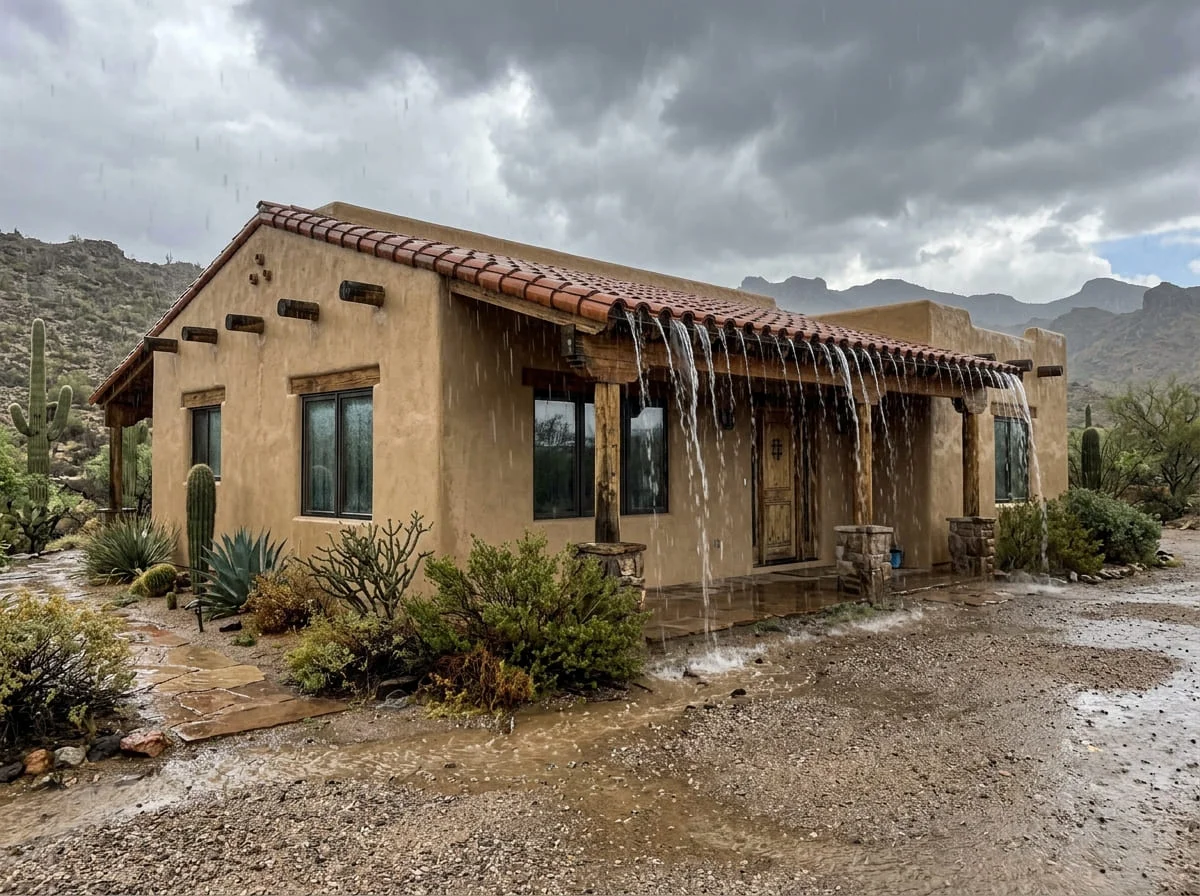
Drive through almost any neighborhood in Phoenix, Scottsdale, or Surprise and you’ll notice something: most homes have no gutters at all. So if you’re wondering whether your house is missing something important — or whether the builder cut a corner — you’re asking a fair question. The honest answer isn’t a simple yes or no. It depends on your roof, your lot, and where the water goes when a monsoon rolls through. Here’s how to tell whether your Arizona home actually needs gutters.
The short answer
Most Arizona homes don’t strictly need gutters everywhere — but nearly every home benefits from gutters in a few key places. Gutters aren’t required by code here, and in a climate that averages only 7 to 9 inches of rain a year, a builder can leave them off and the house will look fine for years.
The problem is that the desert doesn’t deliver its rain gently. Roughly half of the Valley’s annual rainfall arrives in a handful of monsoon storms between June 15 and September 30, when an inch can fall in a matter of minutes. That’s when a gutterless roof turns into a waterfall along your foundation. So the real question isn’t “do I need gutters?” — it’s “where does my roof send water during a hard storm, and is that a problem?”
Why so many desert homes were built without them
There are two reasons your home may have come with bare eaves, and neither means anything is wrong with the house.
Rainfall averages. On paper, the Valley is dry. A builder looking at 8 inches of annual rain reasonably decides gutters are optional, the same way they’d skip a basement or a snow-load roof.
Cost. Gutters add a few hundred to a couple thousand dollars to every house a builder puts up. Across a whole subdivision, leaving them off is real money saved — so tract builders across Arizona simply don’t include them unless a buyer asks.
None of that would matter if our rain behaved like the average suggests. It doesn’t. If you want the full story on this, we dug into it in why new Arizona homes are built without gutters.
What actually happens to a home with no gutters
When there’s nothing to catch the water, every hard rain does the same thing: it sheets off the roof edge and lands in a concentrated line right next to your house. Over time, that causes real damage.
- Foundation trouble. Water pooling against the slab is the big one. Arizona’s caliche-heavy soil doesn’t absorb water quickly, so it sits, saturates, and works its way under the foundation — which can lead to settling and cracks that cost thousands to fix.
- Stucco staining and erosion. Runoff splashes dirt up onto walls and streaks stucco with mud and mineral stains. On the ground, it carves channels through your landscaping and washes gravel and soil away from the house.
- Entryway and walkway pooling. If a roof valley or a long eave dumps water over your front door or a walkway, you get a puddle every storm — annoying at best, a slip hazard and a mud problem at worst.
- Wood rot and mold. Where wide eaves, fascia, or patio structures stay repeatedly wet, the desert sun doesn’t always dry them fast enough, and rot or mold can take hold.
The tricky part is that none of this shows up overnight. It’s slow, quiet damage — which is exactly why so many homeowners don’t think about gutters until they spot a crack or a ruined stretch of stucco.
When your Arizona home genuinely needs gutters
Some homes can get by without gutters. Others really shouldn’t. You likely need them if any of these describe your house:
- Water pools at your entry, patio, or garage after a storm.
- Your lot slopes toward the house, or you’re on a hillside or near a wash — common in Cave Creek, the Rio Verde Foothills, and Fountain Hills — where runoff gathers speed downhill.
- You have wide eaves or big roof valleys that concentrate water into a few heavy streams.
- You’re seeing stucco stains, soil erosion, or mulch and gravel washing away near the foundation.
- You have an older home that’s had years of runoff hitting the same spots.
If, on the other hand, your lot slopes away from the house on every side, your soil drains well, and you’ve never seen pooling or staining after a storm, you may genuinely be fine with little or no gutter. There’s no shame in that — and an honest installer will tell you so.
You rarely need gutters on the entire house
Here’s the part the “you must have gutters” crowd leaves out: most Arizona homes don’t need a gutter on every eave. The smart approach is to protect the runs that matter and skip the ones that don’t.
The priority spots are almost always:
- Over entryways, walkways, and garage doors where you don’t want water dumping.
- Above patios and outdoor living areas.
- On the uphill side of a sloped lot.
- Wherever a roof valley funnels a concentrated stream to one point.
Targeting those problem elevations gets you the protection you need without paying to wrap the whole roofline. When you do add gutters, sizing them for monsoon volume — and putting in enough downspouts to actually move that water away from the house — matters more than the length of gutter itself.
Doing it right in the desert
If you decide your home needs gutters, a few things separate a system that lasts from one that fails in its first monsoon:
- Seamless, not sectional. Seamless aluminum gutters are formed to the exact length of your roofline on site, so there are no joints to leak or pop apart in the heat.
- Correct pitch and enough downspouts. A gutter that isn’t pitched right, or that has too few downspouts, overflows exactly when you need it most. This is the single most common flaw we see on builder-added and DIY gutters.
- Downspouts that carry water away. A downspout that dumps right next to the slab just moves the problem a few feet. Extensions or buried drainage that discharge well clear of the foundation are what actually protect the house.
- UV-rated materials. Cheap finishes go brittle and chalky under the Arizona sun in just a few seasons. Quality aluminum — or copper on higher-end homes — holds up.
If you’re not sure whether your home needs gutters, the cheapest first step is an honest look at where your water goes. A local pro can walk your roofline, point out the runs that actually matter, and give you a written number — with no pressure to gutter the whole house.
Wondering whether your home is one that needs them? A quick, free gutter installation estimate will tell you exactly which runs to protect — or you can read up on the warning signs your gutters are already failing before the next monsoon.