
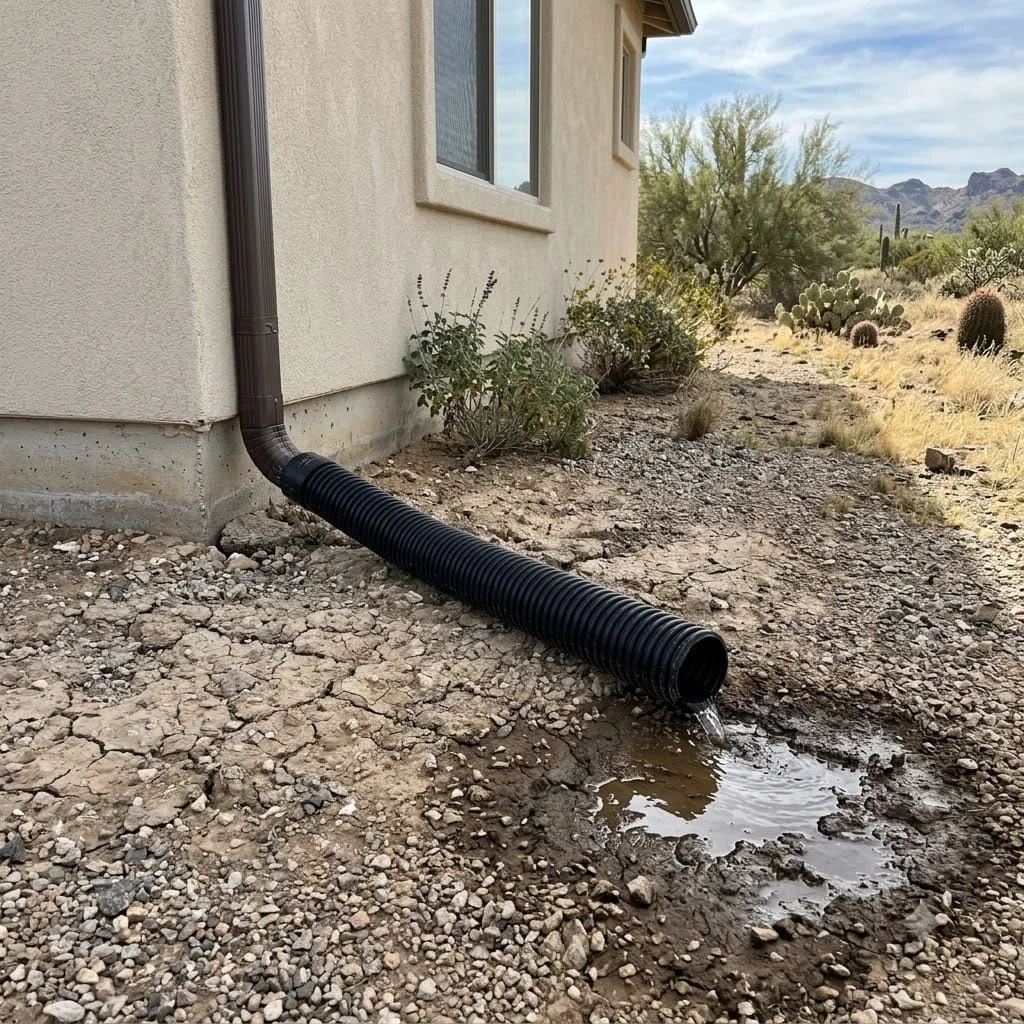
Arizona clay and caliche do not soak up water quickly, so a downspout that dumps beside the slab leaves a puddle at the foundation. Downspouts in the Valley should discharge at least 4–6 feet from the house, and on flat lots a buried line to a lower point is the more reliable fix. A roof with a 2,000 square foot footprint sends roughly 1,200 gallons down its downspouts for every inch of rain.
AZ Gutter Pros installs and repairs downspouts, extensions, and buried discharge lines.
Why the soil behaves this way
Two things make Valley ground bad at absorbing roof water.
The first is caliche, a hardened layer of calcium carbonate that sits a few inches to a few feet below the surface across much of the Valley. Water that reaches it cannot go down, so it spreads sideways, often toward the house.
The second is expansive clay. It swells when it takes on water and shrinks as it dries, and it can move several inches across a season. A downspout that keeps wetting the same patch of clay by the slab subjects the foundation to that cycle every storm.
What poor discharge looks like
Water that pools by the slab after a storm is the clearest sign. Other signs are eroded gravel under the downspout, wet stucco at the base, and planters that flood while the rest of the yard stays dry.
Over time the symptoms move inside: hairline cracks in the garage floor, doors that stick, and baseboard gaps. These are the late-stage results of the same water.
The fixes, from cheapest up
Each step moves the water farther or more reliably.
First, a downspout extension carries water a few feet past the slab. It is the cheapest fix and works on sloped lots with decent drainage.
Second, a splash block or concrete apron spreads the flow. It helps with erosion more than with distance.
Third, a buried discharge line runs through solid pipe to daylight, a catch basin, or a dry well. On flat Valley lots with clay or caliche it is the one that actually solves the problem.
Finally, regrading the soil near the slab so it slopes away. It is often part of a larger landscape job, and the estimate should list it separately.
What it costs
These are market ranges, and the written estimate sets the real number.
- Downspout extension or splash block: commonly under a couple hundred dollars.
- Buried discharge line to daylight or a catch basin: priced per run, depending on length and soil.
- Added downspouts to shorten roof runs: priced per downspout.
- Regrading near the slab: billed separately.
We quote each downspout on its own so you can see which ones matter most.
Where the problem shows up most
New builds in Queen Creek, Laveen, and Litchfield Park often have builder downspouts that stop at the slab edge, which is the exact problem described above. Foothill lots in Cave Creek, Carefree, and Fountain Hills have the opposite issue: fast runoff that has to be directed around, not at, the house.
Older homes in Sun City West, Youngtown, and Tolleson often have original downspouts that have corroded or detached, which is a repair rather than a redesign.
What a good estimate leaves out
A good estimate does not price a full buried drain system where a downspout extension solves the problem, and it does not claim the foundation is in danger when the symptoms do not support it. We don’t sell a drainage package without looking at where the water goes.
The honest version is a short list: which downspouts discharge badly, what each fix costs, and which one to do first. That is what our written estimate gives you.
Get a Free Estimate
A free estimate shows where each downspout discharges and what each fix costs. Request a free estimate or call (602) 536-0941 and we’ll price it in writing. You can also read about gutter installation if the home has no gutters at all.