
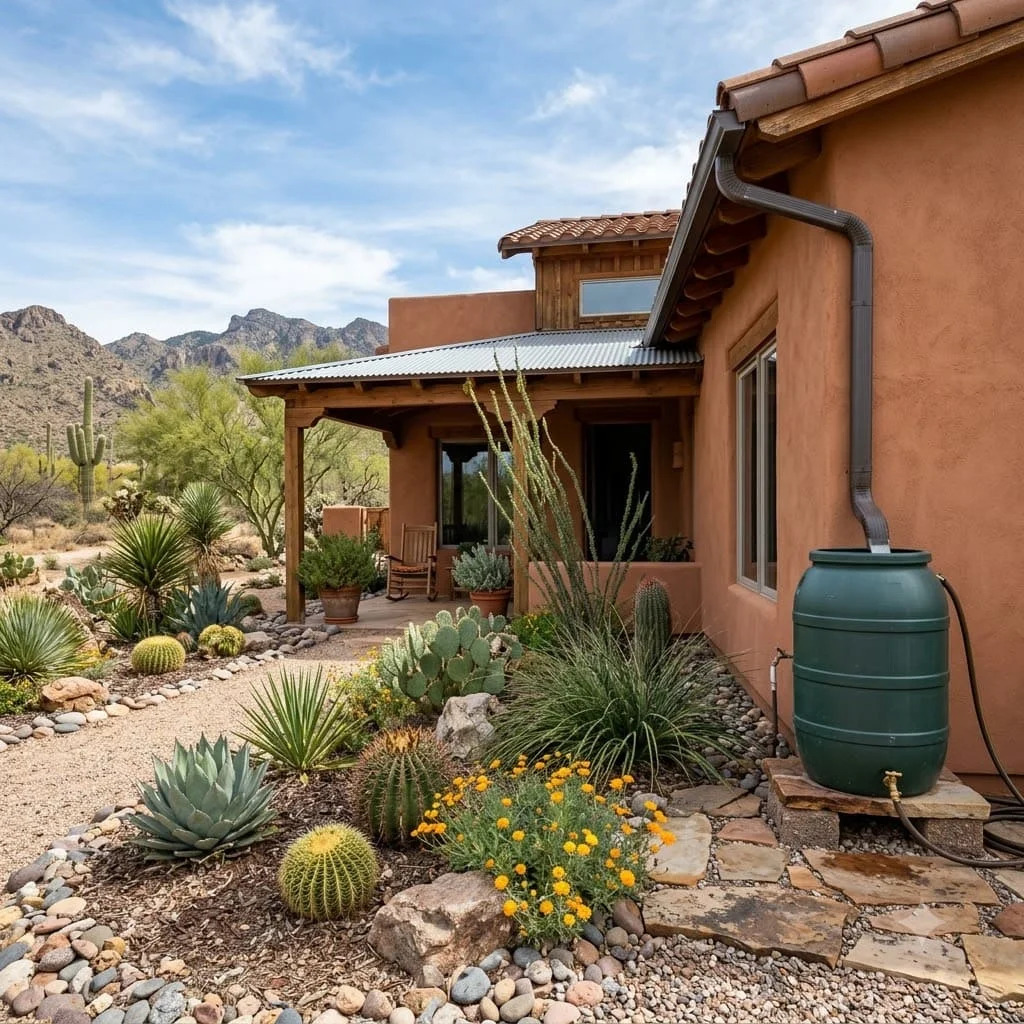
Tucson Water reimburses up to $2,000 toward residential rainwater harvesting, Flagstaff offers a smaller cistern rebate, and Maricopa County cities offered no dedicated rainwater rebate as of October 2026. Every one of these systems starts at the roof, which means working gutters and downspouts decide how much water a barrel or cistern actually catches. This page lays out what exists, what it requires, and where the gutter work fits.
AZ Gutter Pros installs the gutters and downspouts a harvesting system depends on.
Rebates available in Arizona
Programs change, so treat the numbers below as a starting point and confirm them with the provider before buying anything.
Tucson Water. Reimburses up to $2,000 per property for qualifying systems. Published terms pay $0.25 per gallon for systems of 50 to 799 gallons and $1.00 per gallon for 800 gallons or more, up to the cap. Applicants must be Tucson Water customers and complete a class and an application before installing.
City of Flagstaff. Offers a modest rebate for larger cisterns, along with a free rain barrel program for repurposed containers. Check current terms with Flagstaff Water Services.
Phoenix and Maricopa County. No city in Maricopa County was offering a rebate for rainwater collection or storage as of October 2026, based on a search of published program pages. Some cities have landscape and turf rebates, which are separate programs.
State tax credit. Arizona once offered a 25% credit, up to $1,000, for water conservation systems. That program is no longer active.
Is it legal
Yes. Arizona allows residential rainwater harvesting for personal use such as landscape irrigation. Rules on system size, plumbing, and use vary by city, so ask your building department before installing a large cistern.
Where gutters come in
A rain barrel or cistern is only as good as the roof catchment feeding it. Roof water has to be collected along the eave, carried through a downspout, and delivered to the tank.
That means a gutter system sized for the roof, with downspouts positioned where a tank can sit. Retrofitting a tank onto a home that has no gutters starts with gutter installation, and many rebate programs require the catchment to be properly connected.
What roof water needs before it reaches a tank
Valley roofs shed dust, grit, and palm debris. Water that runs off carries all of it into the gutter and then toward the tank.
For that reason, a harvesting setup usually adds a debris filter or first-flush diverter at the downspout, and our gutter guards keep the biggest debris out of the run in the first place. A tank full of fronds and sediment is not much use for irrigation.
What the gutter and downspout work costs
Costs depend on the roof and the tank location, and these are market ranges rather than quotes.
- Seamless aluminum gutters, typical single-story home: about $1,200–$2,500 installed.
- Downspout reroute to a tank location: priced per downspout and quoted in writing.
- Gutter guards on harvesting runs: priced per foot and quoted separately.
Our cost report breaks down installation pricing in more detail.
What to do before you apply
Check the program rules first, because most rebates require pre-approval, a class, or a project plan before installation. Buying a cistern first and applying afterward is the most common way owners miss out.
If the home needs gutters or downspout changes to feed the tank, get a written estimate before you submit the project plan. We’ll tell you how many downspouts can reach the tank location and what each reroute costs.
Where this matters in Arizona
Tucson-area homes in the Foothills and Oro Valley are the strongest fit for the rebate. In Flagstaff, snow and snowmelt make cisterns and barrels practical, and in Sedona and the Verde Valley the same logic applies on a smaller scale.
In the Phoenix Valley there is no rebate, but monsoon runoff still makes a barrel or cistern useful for landscape watering, and the gutters behind it still matter. See our downspout drainage guide for how the discharge side works.
Get a Free Estimate
If the home needs gutters or downspout changes before a tank goes in, a free estimate shows the cost up front. Request a free estimate or call (602) 536-0941, and we’ll quote the work in writing.