
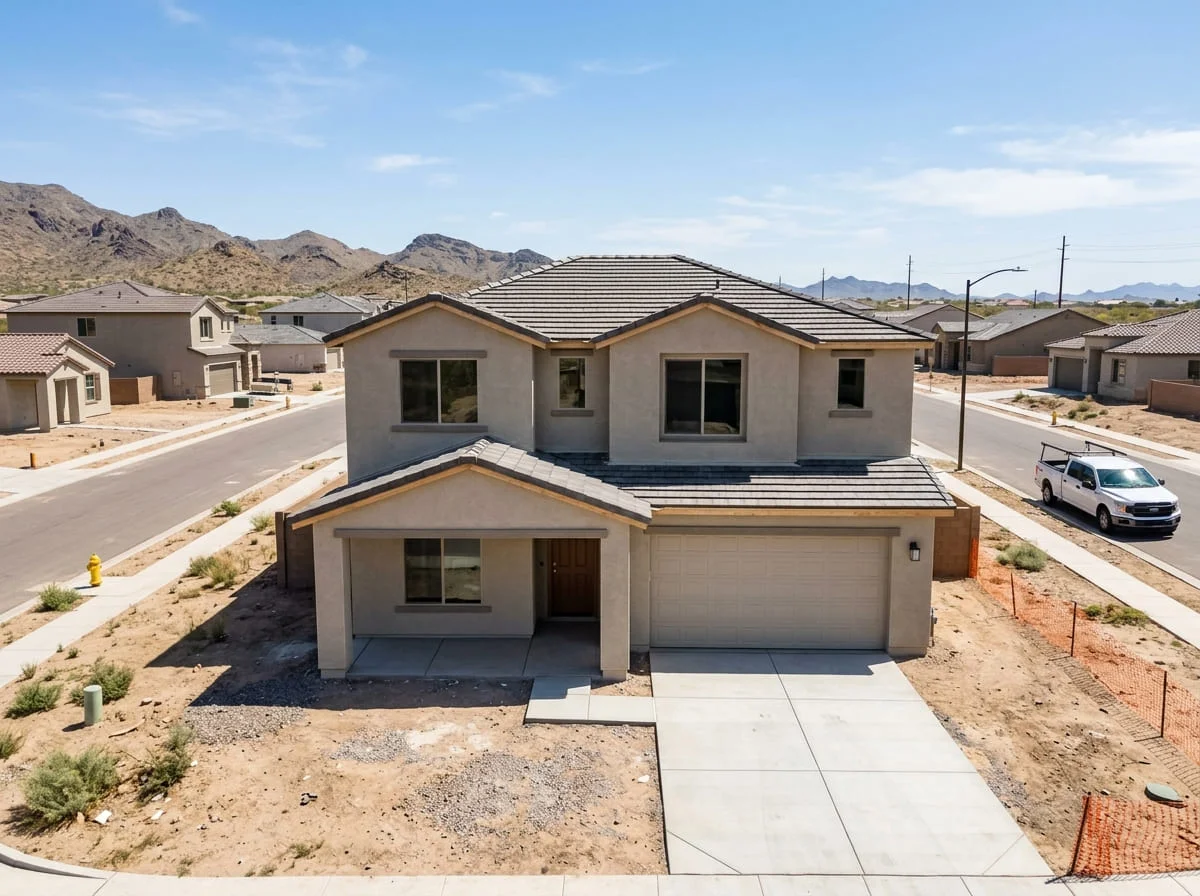
You bought a newer home in Buckeye, Queen Creek, or Surprise, and after the first real storm you noticed something the listing photos never showed: the roof has no gutters. Water just pours off the edges. If you’re wondering whether the builder forgot something — or whether this is normal — here’s the straight answer, and how to decide whether to do anything about it.
The short answer
Arizona builders leave gutters off new homes on purpose, almost always to save money. It’s not a mistake and it’s not a defect. In a state that averages well under 10 inches of rain a year, gutters are treated as optional, and cutting them from the base house keeps the price competitive against every other builder in the subdivision.
That logic holds right up until a monsoon storm drops an inch of rain in fifteen minutes. Then the “optional” gutters you never got are the reason water is sheeting off your roof and pooling against the foundation of a house you just bought.
Why builders skip gutters in the desert
Two forces are at work, and understanding them makes the decision easier.
The rainfall math looks harmless. Phoenix averages roughly 7 to 9 inches of rain a year. To a builder pricing out a house, that number says gutters aren’t essential — so they become a cut. What the average hides is how that rain falls: about half of it comes in violent monsoon bursts, not gentle year-round drizzle. An average that sounds mild still produces roof runoff that can undermine a foundation.
Every dollar counts in a production build. On a tract home, the builder is shaving cost everywhere they legally can. Gutters add a few hundred to a couple thousand dollars per house. Multiply that across a hundred-home subdivision and leaving them off is a serious line-item savings — so unless a buyer specifically pays for the upgrade, they’re gone.
This is the same reason older neighborhoods across the Valley are full of gutterless homes too. If you want the broader picture on whether a desert home needs them at all, we cover that in do Arizona homes really need gutters.
Is a gutterless new home actually a problem?
Sometimes yes, sometimes no — it depends entirely on where your roof sends water. A brand-new home can still have a drainage problem baked in on the day you get the keys.
Watch for these after your first few storms:
- Water pouring over the front door, garage, or a patio. Builders love wide, dramatic eaves and roof valleys, and those concentrate water into heavy streams that land exactly where you walk.
- Pooling against the foundation. New-build lot grading is often set for how the yard looks, not how it drains in a downpour. If water sits against the slab, that’s a problem now — not in ten years.
- Gravel, mulch, or soil washing away in lines beneath the roof edge.
- Mud splashing up and staining fresh stucco.
If you’re seeing any of that, the home has a drainage issue the builder handed off to you — and it’s worth fixing before it compounds.
The new-build punch list nobody finished
Even on newer homes that do have some gutters, we constantly find the same unfinished details:
- Downspouts that dump right next to the slab, moving water a few feet instead of away from the house.
- Too few downspouts for the roof area, so the gutters overflow in the first hard storm.
- Runs left off key elevations — the builder guttered the front for curb appeal but skipped the side where water actually causes trouble.
- Pitch set carelessly, so water pools in the gutter instead of draining to the outlet.
None of these are hard to correct, but they all point to the same thing: builder drainage is designed to pass inspection and look good on move-in day, not to survive a decade of monsoons. Getting enough properly placed downspouts in the right spots often matters more than the gutters themselves.
When to add gutters to a newer home
You don’t necessarily need to wrap the whole roofline. Focus on the runs that matter:
- Over entries, walkways, and the garage door.
- Above patios and covered outdoor areas.
- On any elevation where you’ve seen pooling or erosion.
- Wherever a roof valley funnels a concentrated stream to one point.
The best time to handle it is before your first monsoon season if the home already shows problem spots, or as a pre-closing upgrade if you’re still in the buying process and can negotiate it. If the builder’s upgrade price is steep, a local seamless gutter company can usually do the same work for less after you move in.
The point isn’t to second-guess your builder — they made a normal cost decision. The point is that the decision is now yours, and on a newer home it’s a cheap, easy fix while everything is still in good shape.
Just bought a home with bare eaves and not sure which runs it needs? A free gutter installation estimate will show you exactly where water is causing trouble and what it takes to stop it — usually a smaller job than people expect on a newer home.