
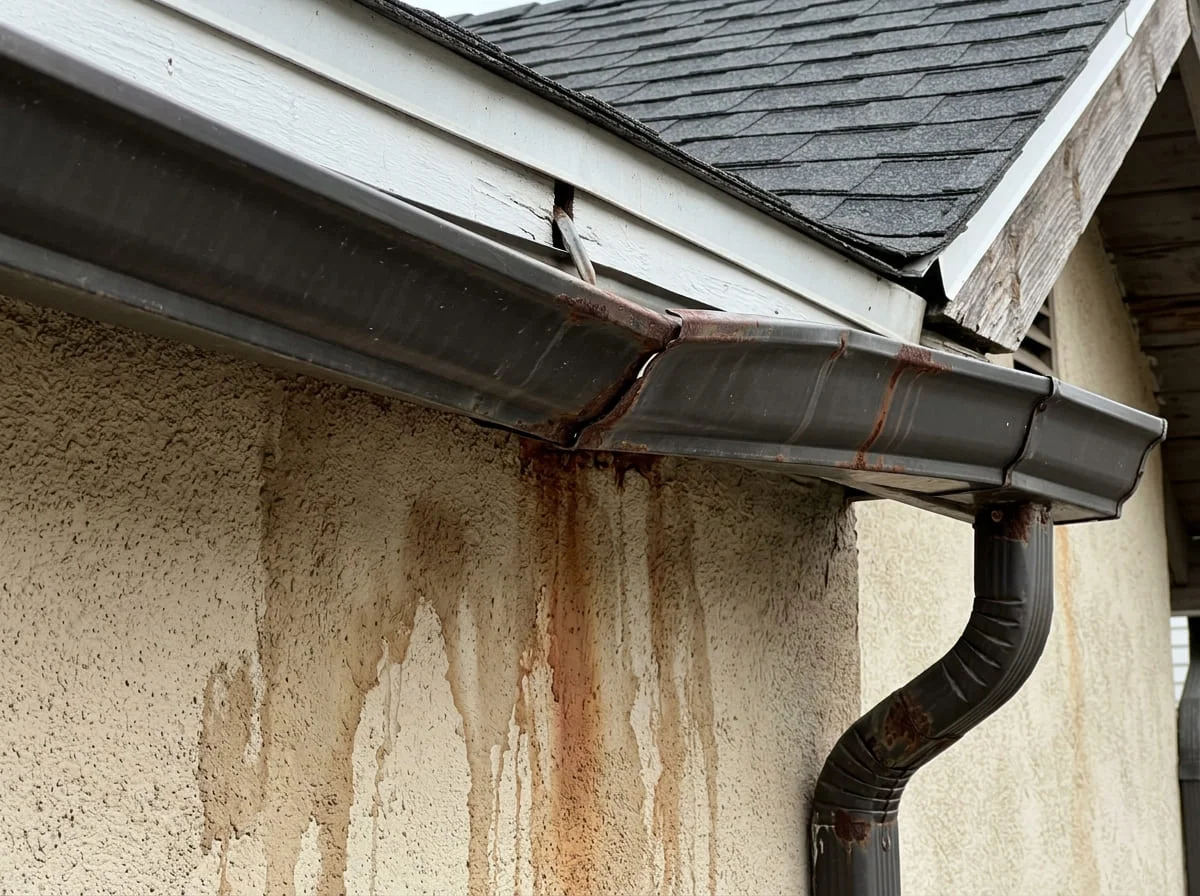
The worst possible time to learn your gutters have failed is in the middle of a July monsoon, watching water sheet down the side of your house at 9 p.m. The good news is that failing gutters almost always warn you first — you just have to know what to look for. Here are seven signs Arizona homeowners should check now, while there’s still time to fix them before the storms arrive.
Check before June 15 — not during the first storm
Monsoon season runs June 15 through September 30, and it brings the heaviest, fastest rain of the year. Late spring is the time to walk your gutters, because a problem spotted in May is a simple repair, while the same problem discovered mid-storm often means water is already hitting your foundation. Grab a few minutes on a calm day and look for the following.
1. Sagging or uneven runs
Stand back and sight down the length of each gutter. It should run in a straight, slightly pitched line. If a section dips, bows, or sags in the middle, the hangers are giving way — usually because packed dust and debris made the gutter too heavy for its fasteners. A sagging gutter holds standing water, drains poorly, and is on its way to pulling off entirely.
2. Gutters pulling away from the fascia
Look at where the gutter meets the house. If you can see a gap opening up, or the gutter is tilting away from the roofline, the fasteners are losing their grip on the fascia. This is one of the most common failures we see in the Valley, driven by the double punch of heavy debris and sun-fatigued fascia board. Once there’s a gap, water runs behind the gutter and down your wall — the opposite of what it’s there to do.
3. Overflow during ordinary storms
If your gutters spill over the edge in a routine monsoon storm — not just a once-a-decade deluge — something is wrong. The usual culprits are a clog, incorrect pitch, or an undersized system with too few downspouts. Overflow dumps water right where you don’t want it, so it’s worth tracking down the cause. Often a thorough cleaning fixes it; sometimes it points to a sizing problem.
4. Brittle, cracked, or chalky metal
Run your eye — and if it’s safe, your hand — along the gutter’s surface. The Arizona sun is brutal on gutter materials. Chalky residue, faded and flaking finish, or hairline cracks mean the metal is sun-fatigued and losing its integrity. Mild cases can be resealed; widespread brittleness usually means the system is nearing the end of its life and is a candidate for replacement.
5. Leaking or separated seams
On sectional (jointed) gutters, the seams are the weak point. Look for water stains, rust streaks, or gaps at the joints and corners. Desert heat expands and contracts the metal daily, working old sealant loose until the seams drip. Resealing buys time, but chronic seam leaks are exactly why seamless gutters — formed in one continuous piece with no joints to fail — are the standard for new installs here.
6. Stains, erosion, or pooling below the gutter
Sometimes the clearest evidence is on the ground and the wall, not the gutter itself. Watch for:
- Streaks or mineral stains on the stucco beneath the gutter line.
- Channels or washed-out gravel and mulch along the foundation.
- A puddle that keeps reappearing at the same spot after every storm.
All three mean water is escaping the system somewhere and hitting the house — a sign the gutter, a seam, or a downspout isn’t doing its job.
7. Downspouts that dump right at the foundation
Follow each downspout to where it ends. If it’s discharging within a foot or two of the slab, it’s just relocating the problem — soaking the soil right next to your foundation instead of carrying water away. Downspouts should route water well clear of the house with an extension or buried drainage. A downspout that’s come loose or lost its extension is an easy fix with an outsized payoff.
What to do with what you find
Not every sign means a big job. Here’s the quick rule:
- Isolated problems — one sagging run, a leaky seam, a few pulled fasteners, a disconnected downspout — are straightforward gutter repairs.
- Widespread failure — brittle cracking metal everywhere, rust throughout, or a system that overflows no matter how clean it is — usually means it’s time for replacement.
Either way, the move is the same: handle it before the monsoon, not during it. A minor repair in May costs a fraction of what foundation, stucco, or landscape damage costs in August.
Spotted one or two of these on your own roofline? A free, no-pressure gutter repair estimate will tell you exactly what’s failing and what it takes to fix it — while there’s still time to beat the first storm.