
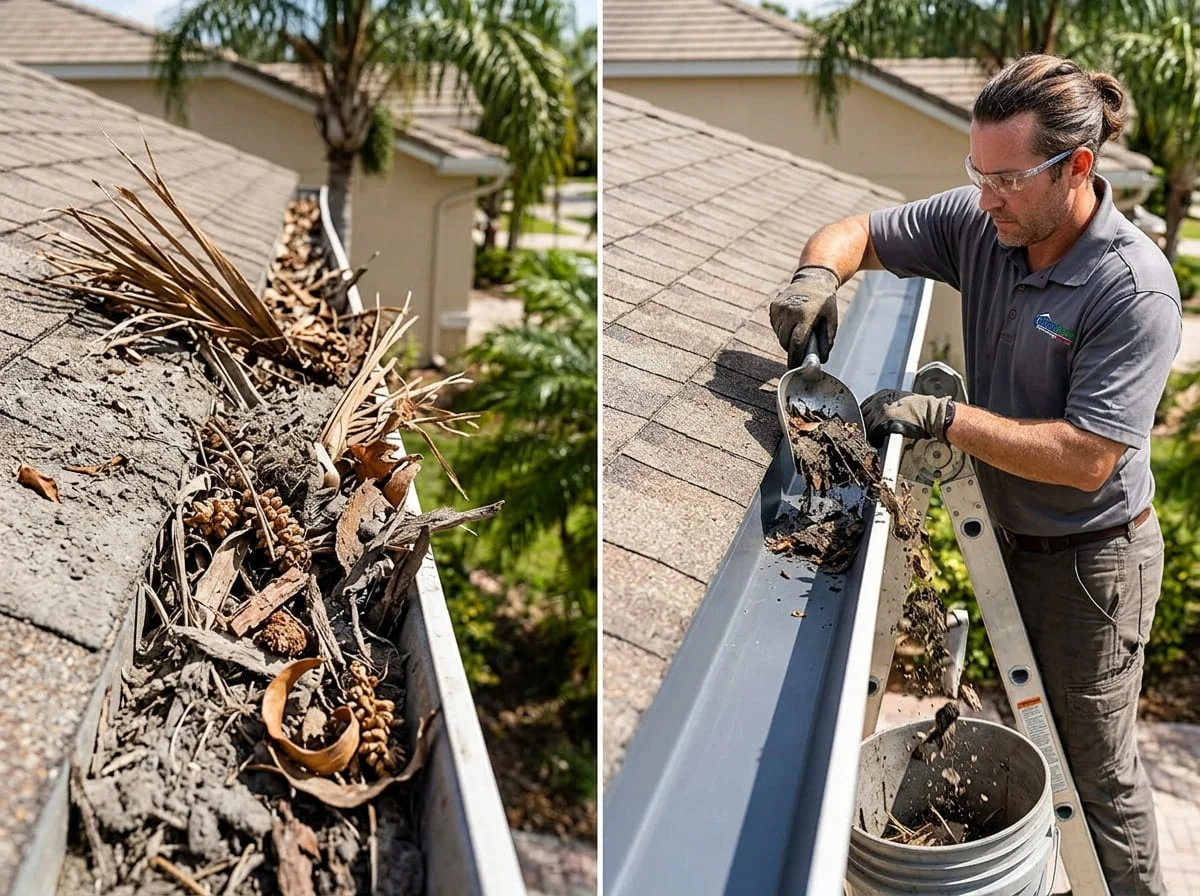
It’s the desert. There are no maple trees dropping a carpet of leaves every fall, so it’s easy to assume gutters here just take care of themselves. Then monsoon season arrives, the gutter overflows, and you realize it was packed solid the whole time. Arizona gutters absolutely get dirty — they just fill with different stuff, on a different schedule. Here’s how often to actually clean them.
The short answer
Clean your gutters twice a year: once in late spring before monsoon season, and once in early fall after the storms pass. For the majority of Valley homes, that rhythm keeps the system clear when it matters and catches the debris the summer leaves behind.
Some homes need a little more, some a little less — a property ringed by mature palms will clog faster than a low-landscape lot with gutter guards. But if you remember nothing else: the pre-monsoon cleaning in May is the one you never skip. That’s the difference between gutters that carry the heaviest rain of the year and gutters that overflow onto your foundation during it.
Wait — gutters get dirty in the desert?
They do, just not from leaves. Swap “autumn leaves” for this list and you’ll see why:
- Blown dust. This is the big one. Fine desert dust settles into gutters and, once a little moisture hits it, hardens into a crusty, cement-like layer that’s genuinely harder to clear than wet leaves.
- Palm debris. Fronds, seed pods, and stringy palm fiber are everywhere in the Valley, and they jam downspouts fast. If you’ve got palms near the house, they’re your number-one gutter problem. We wrote a whole piece on the palm debris problem if that’s your situation.
- Mesquite and palo verde litter. Desert landscaping drops tiny leaves, pods, and blossoms that accumulate quietly all year.
- Roof grit and granules. Storms wash sand and shingle grit off the roof and straight into the gutter.
- Nests. Birds and rodents like a sheltered, dry gutter — especially a partly clogged one.
Any of these will block a downspout just as effectively as leaves. The desert doesn’t spare your gutters; it just clogs them with its own materials.
The Arizona cleaning calendar
Timing matters more here than almost anywhere, because our rain is so concentrated. Here’s the schedule that fits the Valley’s weather:
| When | Why it matters |
|---|---|
| Late spring (≈ May) | The essential one — clears a winter and spring of dust and debris so the system is ready for monsoon season, which starts June 15. |
| Early fall (≈ October) | Clears out the fronds, grit, and washed-down debris the summer storms leave behind, so nothing sits packed in the gutter all winter. |
| Extra clean (as needed) | Homes with heavy palms, mesquite, or overhanging trees often need a mid-season check, especially after a big dust storm. |
The logic is simple: clean before the water comes, and clean again after it stops. A gutter that’s spotless in April but packed solid by late June isn’t doing you any good when the first big storm hits.
What happens if you just… don’t
Skipping cleanings doesn’t cause a dramatic failure right away — it’s a slow build. Dust and debris accumulate, the channel narrows, the downspout chokes, and everything looks fine from the ground. Then a monsoon dumps an inch of rain in minutes onto a system that can’t move it, and the water goes over the edge — straight down onto the foundation the gutter was installed to protect.
Left long enough, a clogged gutter causes its own damage too:
- Standing debris holds moisture against the fascia and roof edge, which can rot wood over time.
- The added weight of packed, damp debris pulls gutters loose and bends the hangers.
- Overflow erodes landscaping and stains stucco, undoing the whole point of the system.
At that stage you’re not looking at a cleaning — you’re looking at a repair. Regular clearing is far cheaper than fixing a sagging, pulled-away run.
Should you clean them yourself?
If you have a single-story home and you’re steady and safe on a ladder, you can do it: gloves, a scoop, and a hose will handle most of it — though baked-on dust takes some real scrubbing.
But be honest about two things. First, Arizona heat makes summer ladder work genuinely dangerous — clearing gutters at 105 degrees is how people get hurt. Second, two-story and hillside homes raise the risk fast, and that describes a lot of properties in the foothills of Cave Creek, Fountain Hills, and Carefree.
That’s why so many homeowners — especially retirees in Sun City West and Youngtown — simply put cleaning on a set twice-a-year schedule with a pro. Nobody climbs anything, and the gutters are always clear before the season that needs them.
If you’d rather not be on a ladder before this monsoon season, a professional gutter cleaning is a quick, flat-fee visit. We clear the runs and downspouts, flush the system, and tell you if anything needs attention — so you head into the storms with gutters that actually work.