
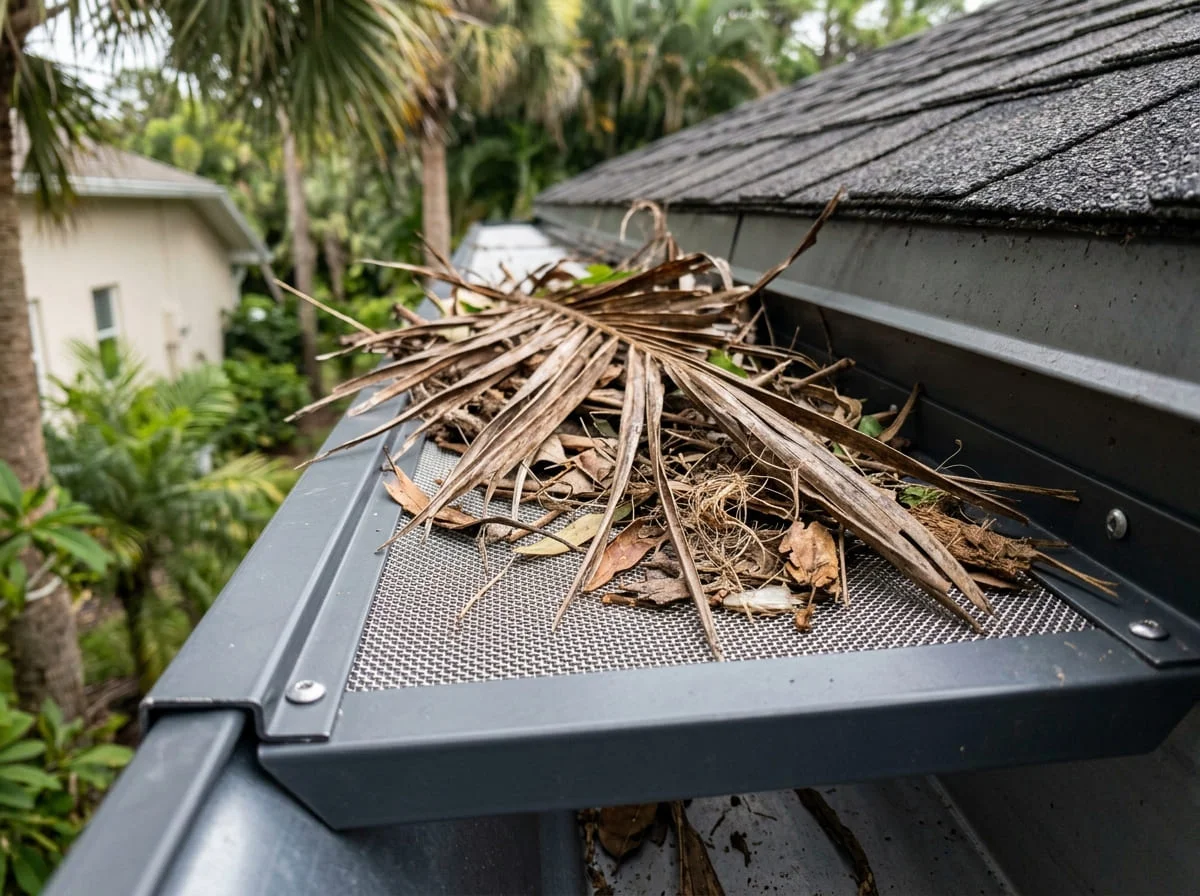
Most gutter-guard advice you’ll read online was written for someone in Ohio whose gutters vanish under oak leaves every October. That’s not your problem. In Arizona, the enemies are fine blown dust and palm debris — and they behave completely differently from leaves. That changes which guards actually work here, and which ones are a waste of money. Here’s what holds up in the desert.
The short answer
Stainless micro-mesh guards are the ones that work in Arizona. They stop the palm fronds, seed pods, and roof grit that clog Valley gutters, while still letting a hard monsoon’s water through. The only thing no guard fully blocks is the very finest dust and pollen, which can settle on top of the mesh and need an occasional rinse.
So the right expectation isn’t “never touch my gutters again.” It’s turning two or three messy clean-outs a year into one quick rinse — a genuine, worthwhile reduction, especially if you’ve got palms.
Why Arizona’s debris is a different problem
Guards are designed around the debris they’re meant to block, so it matters that ours isn’t leaves:
- Palm fronds and fiber. Stringy, tough, and everywhere in the Valley. This is the debris that jams downspouts fastest, and it defeats cheap guards that trap the fiber instead of shedding it.
- Seed pods and blossoms. Mesquite, palo verde, and ornamental trees drop small, hard debris that piles up quietly.
- Fine blown dust. The desert’s signature challenge. It’s so fine it can pass through or settle onto almost anything, and once it’s wet it sets like cement.
- Roof grit. Storms sluice sand and shingle granules straight off the roof into the gutter.
A guard that’s great against broad flat leaves can be useless against stringy palm fiber and powder-fine dust. That’s why “best gutter guard” lists written for the rest of the country don’t transfer to Phoenix.
What works — and what to skip
Here’s how the common guard types actually perform against desert debris:
- Stainless micro-mesh (best). A fine metal mesh on a solid frame. It blocks fronds, pods, fiber, and grit while passing high monsoon flow. It’s the right answer for the vast majority of Valley homes, and especially any home with palms.
- Perforated aluminum panels (decent). Small punched holes stop larger debris and hold up to the sun. They let more fine dust through than micro-mesh but are a reasonable mid-tier choice on low-debris lots.
- Wide-slot screens (weak here). Big gaps let palm fiber, pods, and dust right through, so they barely reduce cleaning. Skip them if you have palms.
- Foam inserts (avoid). Foam sitting inside the gutter traps fine dust and palm fiber, holds moisture, and breaks down under UV. It’s the wrong tool for this climate.
The pattern is simple: the finer and more sun-stable the guard, the better it handles Arizona. Cheap, coarse, or foam-based products tend to trap our specific debris rather than shed it.
Where guards make the biggest difference
Gutter guards earn their keep fastest on:
- Homes with palms, mesquite, or overhanging trees — anywhere a lot of debris lands on the roof.
- Two-story and hillside homes in areas like Cave Creek, Fountain Hills, and Carefree, where cleaning means risky ladder work.
- Homes owned by anyone who shouldn’t be on a ladder — a real consideration in retirement communities like Sun City West, where nobody should be clearing gutters in summer heat.
If your lot has almost no surrounding vegetation, the math is closer, and a straightforward twice-a-year gutter cleaning may be the more economical path. The deciding factor is always the same: how much debris actually reaches your roof.
The honest limitation
No guard beats dust completely, and any company that promises “never clean your gutters again” is overselling. Fine desert dust and pollen can collect on top of even the best micro-mesh, and once in a while you’ll want to rinse it off so water passes through freely.
But compare the two chores. Without guards, you’re scooping packed, cement-hard dust and rotting palm fiber out of the channel two or three times a year. With good micro-mesh, you’re giving the top of the mesh an occasional hose-down. That’s the trade — not zero maintenance, but dramatically less of it, and no more digging clogs out by hand.
Adding guards the right way
A few things determine whether guards perform:
- Start with sound gutters. Guards can go on existing seamless gutters as long as they’re properly pitched, secure, and not sagging or corroded. Putting guards on a failing gutter just protects a system that’s already on its way out — fix the gutter first. (Not sure? These are the signs a gutter is failing.)
- Match the guard to your debris. Heavy palms call for fine micro-mesh, full stop.
- Keep the downspouts in the plan. Guards keep the channel clear, but water still has to exit — enough properly placed downspouts matter as much as the guard on top.
Tired of clearing palm fronds and baked-on dust out of your gutters every year? A free gutter guard assessment will tell you whether your current gutters are a good candidate and which mesh actually fits your home’s debris — no pressure, just a straight answer.