
Gutter Installation & Repair in Paradise Valley, AZ
A parapet roof does not shed along an edge — it fires a single jet through a canale. AZ Gutter Pros fits the collector heads and leaders that catch it before it reaches your stucco.

Your local gutter company in Paradise Valley.
A good share of the estates in Paradise Valley have no eave. The roof is flat or very low slope, and it stops at a vertical parapet wall. The water leaves through a hole. That is either a scupper cut through the parapet or a projecting canale, in the territorial and Santa Fe idiom this town has built in for eighty years. There is no fascia board. There is nothing to hang a gutter on, and no continuous edge for one to sit under. So half the conversations we have in 85253 begin the same way. We explain that the thing being asked for is not the thing the house needs.
AZ Gutter Pros works across Paradise Valley — the slopes of Camelback and Mummy Mountain, Clearwater Hills, Cheney Estates, and the corridors along Tatum and Lincoln.
What a parapet roof needs is a collector head and a leader. The collector head, sometimes called a conductor box, is an open vessel that mounts on the wall directly beneath the outlet. It takes the impact of the discharge, holds a few seconds of volume, and hands it down to a leader that carries it to grade. That is not a decorative flourish, though a copper one certainly reads as such on the right house. It is the piece that stops a concentrated stream from hitting stucco at speed, and on a large estate roof the stream in question is a genuinely violent thing.
The rest of what we do here is ordinary in kind and unusual in scale. Most Paradise Valley homes do have some pitched sections, over a wing, a casita, a porte cochère. Those get conventional seamless runs, sized against a roof area far larger than a suburban house presents. The lots are an acre and up, and the discharge distances are long. What sits below the outlet tends to be pool decks, stone terraces and mature landscape rather than lawn. Where the water goes matters as much as how you collect it. Both go on the written quote before we fabricate anything.
Neighborhoods & areas we cover in Paradise Valley
Every gutter service, available in Paradise Valley.
Seamless Gutters in Paradise Valley, AZ
For the pitched sections a parapet house still has — the casita, the porte cochère, the wing with a tile roof. Formed on site and sized against the roof area we measure rather than a nominal figure, which on an estate runs much larger than it looks.
Gutter Cleaning in Paradise Valley, AZ
On a flat roof the thing that has to stay clear is the scupper mouth and the drain sump, not a trough. A blocked outlet ponds water on the deck, and ponded water is dead load your roof structure was not asked to carry indefinitely.
Gutter Guards in Paradise Valley, AZ
Mesh over a scupper mouth is a trap, not a guard — it blinds the one outlet the roof has. Screening belongs at the collector head, where you can reach it and clear it, and on the pitched runs where a conventional guard makes sense.
Downspout Installation & Repair in Paradise Valley, AZ
Collector heads and leaders, sized to swallow a canale discharge without backing up. Carried to a release point clear of pool decks, stone terraces and the root zones of mature planting.
Not sure which you need in Paradise Valley? Call (602) 536-0941 and we’ll point you the right way.
The advantage of hiring locally in Paradise Valley.
Local, so we arrive fast
Paradise Valley sits inside the core coverage area, which means quick scheduling — often within the same week for repairs and cleanings.
We know the local weather
We size and pitch systems for how storms actually hit the central Valley between Camelback and Mummy Mountain, not a mild national average that overflows in July.
Honest, written pricing
You get a clear written estimate before any work starts. The number we agree on is the number you pay — no surprises.
A canale fires a jet at one point. That is not the same problem as an edge that drips.
Understand the discharge and everything else follows.
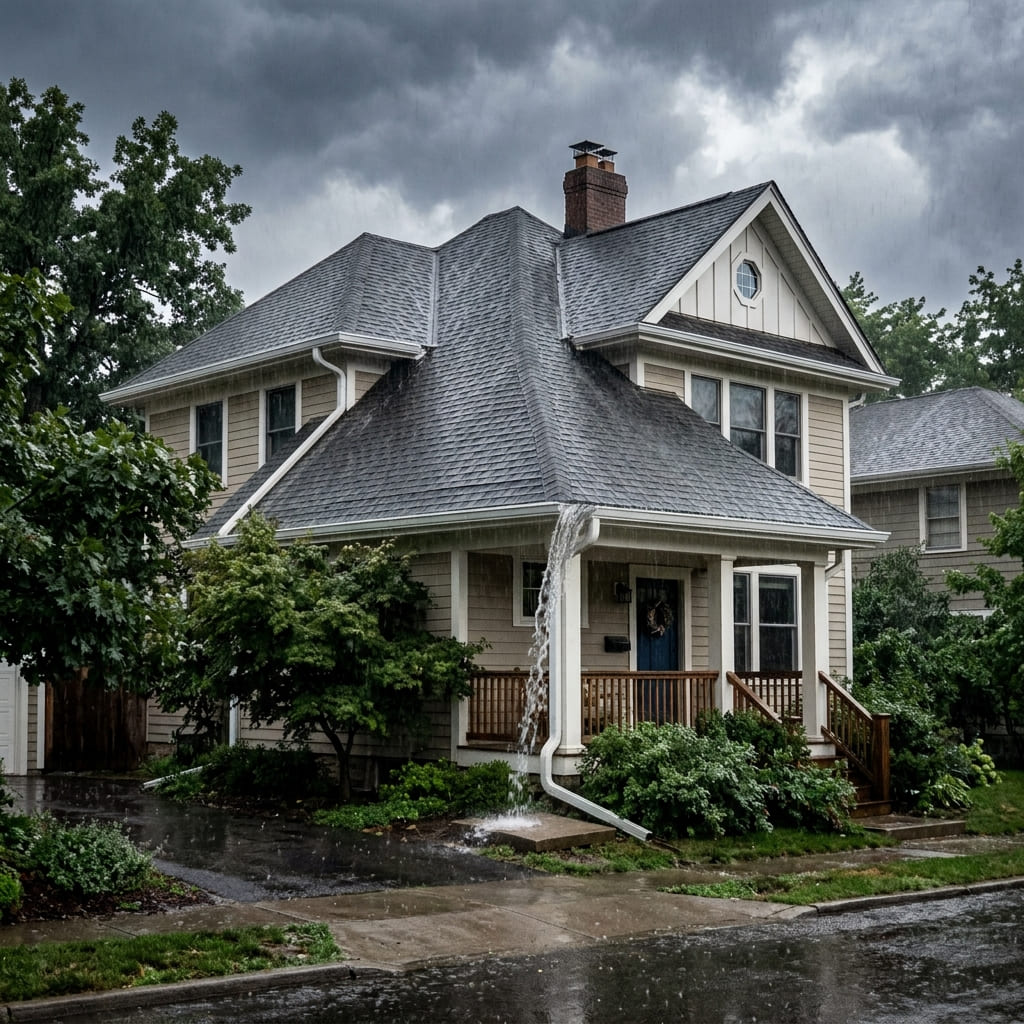
A pitched roof with a gutter distributes its work: water arrives along the whole eave, the trough spreads the load, and several outlets share it. A parapet roof does the opposite. The entire deck grades to a small number of scuppers. One storm cell on ten thousand square feet of roof leaves through two or three openings. It leaves under a head of water with real force behind it. Anyone who has stood on a Paradise Valley terrace during a July cell has seen what that looks like. Not a stream but a jet, arcing several feet out from the wall. Put nothing beneath it and the consequences are predictable. Stucco takes a beating and stains. The base of the wall stays wet well after the sky clears. The flagstone or pool coping below gets undercut as the bedding sand migrates. And where a canale sits above a courtyard, that courtyard is unusable for the duration.
A collector head solves it by absorbing the impact and converting a jet into a controlled fall. Size matters here in a way it does not on a residential downspout. The box has to swallow the peak without spilling over its own rim. The leader below has to move that volume without backing the box up. Undersize either and you have built an ornament. We size both against the tributary roof area feeding that scupper, which means measuring the roof rather than counting the outlets.
The second thing about a flat roof is that it has a fixed capacity, and that changes what maintenance is for.
You can upsize a gutter. A scupper is a hole cut through a structural parapet, and the builder fixed its dimensions when the roof went on. So when a primary outlet blocks, there is no reserve capacity to fall back on. And they do block — on dust, on wind-blown litter, on the gravel from an aging built-up roof. What stops the roof ponding at that point is the overflow scupper, the second, higher opening that most well-built parapets have and that many homeowners have never noticed. If yours is missing, painted over, or itself obstructed, then a single blocked primary means water standing on your deck. Standing water is dead load. Reckon roughly five pounds per square foot for every inch of depth, across an area measured in thousands of square feet. That is the reason we check outlets and overflows on every visit rather than only looking at the parts that hang off the building.
Where our work stops is worth naming. We fabricate and fit collector heads, leaders, and the discharge that takes water away at grade, and we clear scuppers, sumps and drains. We do not touch the roof membrane, and we do not cut new penetrations through a parapet. Your roof may need an overflow scupper it never had, or the flashing at an existing one may have failed. Either is a roofing contractor working on the waterproofing system. That belongs to another trade, and we will refer you rather than improvise around it.
Good to know before you call in Paradise Valley.
My Paradise Valley house is flat-roofed. Can you even put gutters on it?
Not in the ordinary sense, and that is the right answer rather than a limitation. A parapet roof has no eave and no fascia, so there is nothing for a trough to hang from and no edge for it to sit under. What the house takes instead is a collector head fixed to the wall under each scupper or canale, with a leader carrying the water down to a discharge at grade. That assembly does the same job a gutter does on a pitched roof, and on a copper or painted-steel house it can look considerably better. Any pitched sections you do have — a casita, a covered entry, a tiled wing — take conventional seamless runs.
What is a canale, and why does the wall below mine keep staining?
A canale is the projecting spout that carries water out through a parapet on territorial and Santa Fe architecture. The staining is what happens when nothing catches what it delivers. The whole roof drains to a handful of outlets, so the discharge is not a trickle. It is a concentrated jet leaving under pressure, arcing out from the wall and then breaking up. Some of it runs back against the stucco, carrying roof dust and any rust or copper wash with it. That keeps the wall base damp long after the rain has passed. A correctly sized collector head under the canale intercepts the jet at the source, which stops the staining and stops the saturation at the same time.
Should I put mesh over my scuppers to keep debris out?
Please do not. On a flat roof the scupper is very often the only outlet serving a large area of deck. Cover its mouth with mesh and you give debris a surface to build a mat against. Instead of an outlet that occasionally needs clearing, you get one that blinds itself in a single storm and leaves the water standing on the roof. Screening in a parapet system belongs at the collector head. It sits at eye level, lifts straight out, and cannot block the roof if it fouls. Keeping the deck swept and the outlets checked before monsoon season does the rest.
How much water does a large estate roof actually produce?
More than the number people expect, which is the whole argument for sizing properly. An inch of rain over a thousand square feet is a little over six hundred gallons. A ten-thousand-square-foot roof taking that inch — an ordinary July cell in this town — sheds something over six thousand gallons. It does that in perhaps twenty minutes rather than over a day. Divide that between two or three scuppers and the instantaneous flow through each one is substantial. That is why we measure the tributary area feeding each outlet and size the collector head and leader to it, rather than fitting a standard box and hoping.
Do you work around gated properties and estate managers?
Routinely, and it is the normal arrangement here rather than a special request. We can deal with a property manager or estate manager directly for scheduling and reporting. We work around events and pool service, and keep site work to arranged hours where a household needs quiet. Tell us the gate and access situation when you book. Scope, timing and any travel go on a written quote in advance. If your management company has paperwork requirements for contractors on site, raise them when you book so we can deal with them before the first visit.
Serving Paradise Valley and surrounding areas.
Proudly covering Paradise Valley (85253) and nearby Scottsdale, Phoenix, Fountain Hills, Tempe, Mesa — plus much of the central Valley between Camelback and Mummy Mountain. Not sure if you’re in range? Just call and ask.