
Gutter Installation & Repair in Miami, AZ
If your gutter looks clean and dry while the wall underneath it is staining, the water is going behind it — and on an old metal roof with no drip edge, that is exactly what it was always going to do. AZ Gutter Pros fixes the roof edge, not just the trough.
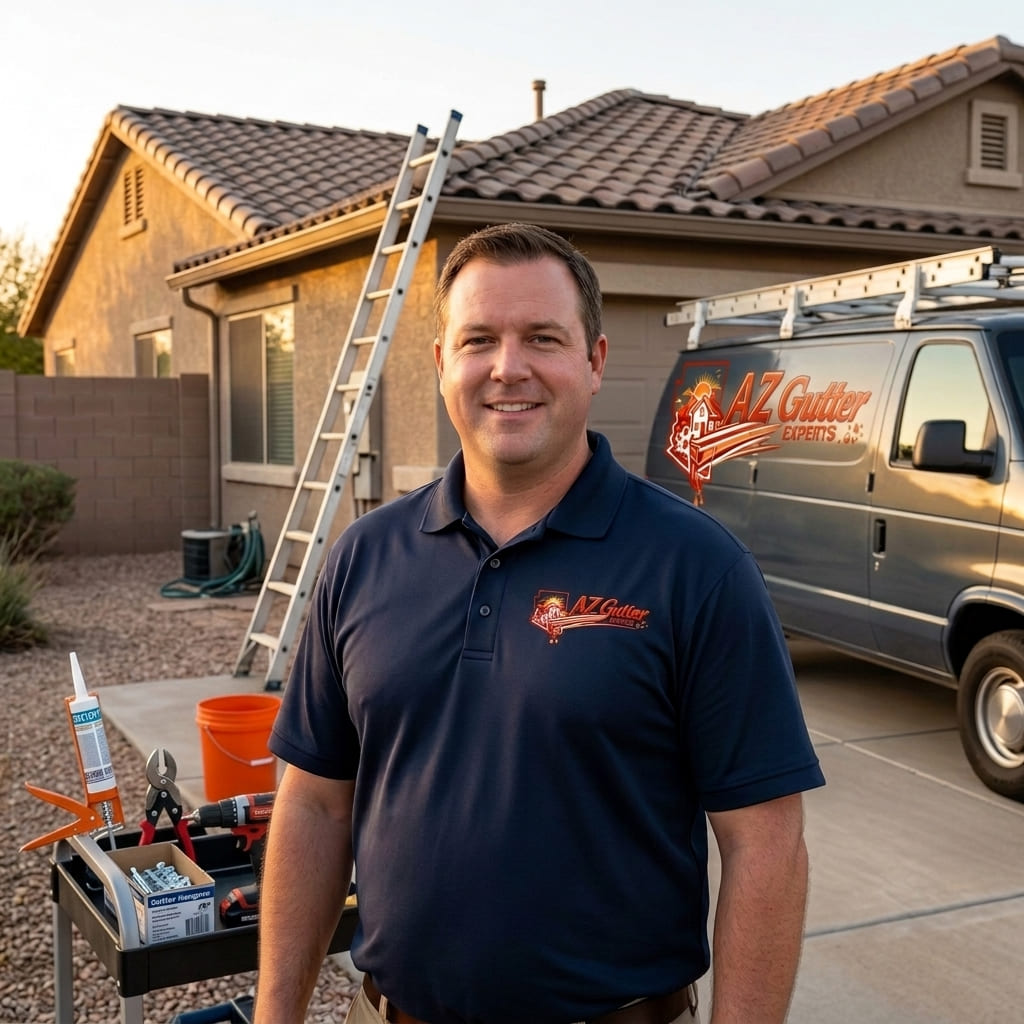
Your local gutter company in Miami.
Miami went up in a hurry after 1907, built to house the men working the concentrator and the smelter works, and the housing that survives tells you exactly that. Small bungalows and company-built cottages on tight lots, low pitches, short eaves, and above a great many of them a corrugated or exposed-fastener metal roof that has been replaced two or three times since the original build. The town holds a fraction of the people it once did, which means a large share of that stock has been repaired by whoever was available rather than re-detailed properly.
AZ Gutter Pros works across the town and the settlements strung along the highway with it — the blocks around Sullivan Street, the housing up at Keystone and Golden Hill, Miami Gardens, and out through Claypool and Central Heights toward Globe.
The complaint we get called about here is a specific one and it confuses people, because on the face of it the system looks fine. The trough is clear. The outlet drains. There is no sag, no split, nothing you would photograph. And yet the fascia behind it is soft, the paint is lifting on the wall below, and after a storm there is a wet line on the ground that is nowhere near where the downspout puts it. The gutter is not failing. The water is simply never getting into it.
That happens because of what is — or more accurately, is not — at the very edge of the roof.
A metal panel that stops in a plain cut edge above the trough does not throw water off cleanly. Surface tension holds the sheet against the metal, and it curls around the cut and runs back along the underside of the pan, travelling in toward the building instead of dropping. It gets to the fascia board, soaks it, and drips down the back of the gutter, which is precisely the one place nobody looks. A drip edge or eave trim with a kick in it breaks that path in about an inch of bent steel, and it is the cheapest component on the whole roof. Its absence is the single most common reason a gutter repair in this town has to start above the gutter.
Neighborhoods & areas we cover in Miami
Every gutter service, available in Miami.
Seamless Gutters in Miami, AZ
Hung to the roof plane rather than to whatever line the last fitter used, with the back leg set high enough behind the panel edge that water cannot get past it. On a metal roof the mounting height is not a detail — it is most of the job.
Gutter Cleaning in Miami, AZ
Miami roofs shed less organic litter than they do fine grit and fastener washers, and both work their way down and lie flat along the floor of the trough. We clear it and look at the eave line while we are up there, because a dry trough over a wet wall means the problem is behind you.
Gutter Guards in Miami, AZ
On low-pitch panel roofs the honest answer is often no. Debris load here is light, and a guard sitting proud of a shallow slope can hold water at the edge rather than shed it. We will say when it is not the right spend.
Downspout Installation & Repair in Miami, AZ
Tight lots leave very little room between the wall and the boundary, so the drop position matters more than usual. We take the outlet where the ground can actually take the water, not simply where the corner is nearest.
Not sure which you need in Miami? Call (602) 536-0941 and we’ll point you the right way.
The advantage of hiring locally in Miami.
Local, so we arrive fast
Miami sits inside the core coverage area, which means quick scheduling — often within the same week for repairs and cleanings.
We know the local weather
We size and pitch systems for how storms actually hit the Globe–Miami mining district, not a mild national average that overflows in July.
Honest, written pricing
You get a clear written estimate before any work starts. The number we agree on is the number you pay — no surprises.
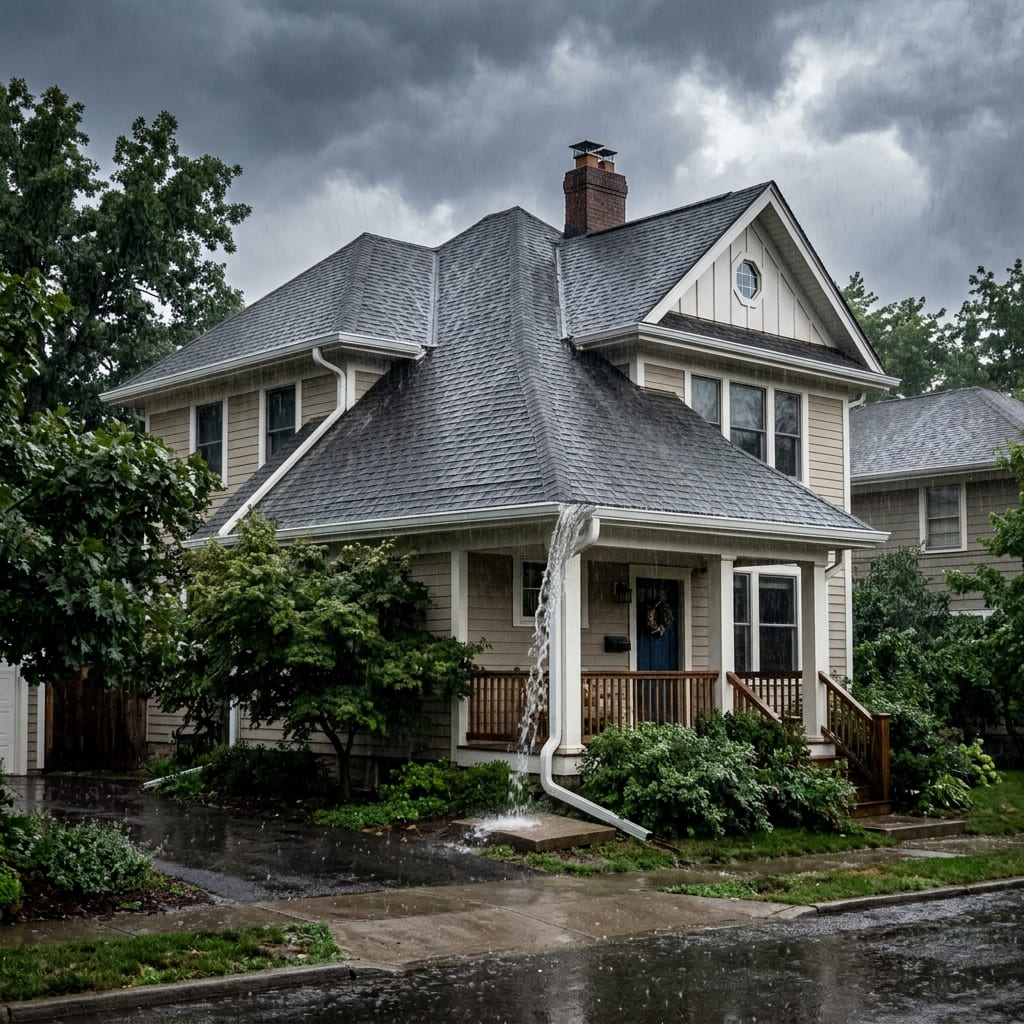
A cut panel edge sends the water backwards, and it never touches the gutter you paid for.
The mechanism is easy to demonstrate and almost impossible to see from the ground.
Run water off a sheet of metal with a plain cut edge and it does not launch clear. A film clings to the surface, wraps around the edge, and travels along the underside in the opposite direction to the fall — the same effect that makes a teapot dribble down its own spout. On a roof, the underside of that panel leads straight to the fascia and the top of the wall. So the water arrives at exactly the structure the gutter was installed to protect, and it arrives behind the trough, where it is invisible. Homeowners report it as a mystery: clean gutters, no overflow, and a rotting eave. It is not a mystery. It is a missing piece of trim. The cure is an eave or drip trim tucked under the panel and turned down with a small kick, so the film has to leave the metal and fall into the trough. On some roofs there is enough panel overhang to work with and the fix is trim alone. On others the panel simply does not project far enough past the fascia, and the honest answer is that the roof edge has to be re-detailed before any gutter on it will behave.
Two things follow from that, and both are worth knowing before you agree to anything.
The first is a limit. Eave trim is roofing material, and fitting it properly means lifting the bottom edge of the panel and working with the fasteners along that course. Where that can be done cleanly we do it as part of the gutter job and it is not expensive. Where the panel is brittle, the fastener holes are elongated, or the last course has been sealed down with mastic by a previous repair, lifting it is a roofing decision rather than a gutter one, and we will tell you to get a roofer rather than take your money and hope. Anyone who offers to solve a back-tracking edge with a bead of sealant along the top of the gutter is selling you a repair that lasts one season. The second is about sequence: in Miami it is worth settling what the roof edge is doing before you spend on the trough, because a correct, level, properly sized run hung under an edge that leaks backwards is a correct, level, properly sized run that will not stop your fascia going. If you are already planning a gutter replacement, that is the moment to deal with both, and it costs far less than doing them in two visits a year apart.
Good to know before you call in Miami.
My gutters are clean and the wall is still getting wet. What is going on?
That combination almost always means the trouble is above the gutter rather than inside it. If the trough is clear, draining, and correctly pitched, and the fascia behind it is still soft, then water is bypassing it — running around the cut edge of the roof covering and back along the underside until it reaches the board. You can sometimes confirm it from a ladder during a storm, or afterwards by looking for staining on the back face of the gutter and the top of the fascia where nothing should ever be wet. The fix is a piece of turned trim at the edge, not a bigger gutter. Anybody who responds to that description by quoting you a full replacement has not diagnosed it.
What is a drip edge, and does an old metal roof need one?
It is a narrow strip of formed metal at the bottom of the roof plane, tucked under the covering and turned down at the front so water has to leave the surface and fall. Yes, a panel roof needs one, and a lot of the older re-roofs in this town do not have it — either it was never fitted, or it was and it has corroded away at the fixings. Pound for pound it is the least costly item on the building, and nothing else protects a fascia as effectively. When we quote a run on a metal roof here, the state of that edge is the first thing we look at and it appears separately on the estimate so nothing is buried inside a single figure.
Are gutters even worth it on a small Miami house?
On most of them, yes, but not for the reason people assume. Rainfall totals here are modest and the debris load is light, so the case is not really about volume. It is about where a short eave puts the water: these houses have very little overhang, so an unguttered roof drips onto ground barely a stride from the footing, over and over, for decades. That is what you are buying out of. Where we will tell you it is not worth doing is on a detached shed or a lean-to with nothing underneath worth protecting and no wall taking the splash. We would rather price the two elevations that matter than wrap the building for the sake of symmetry.
Can you fit gutters if the fascia is already damaged?
We can once the damage is dealt with, and we will not hang anything on a board that has gone soft, because a loaded run is heavy and it will pull straight out. What happens in practice is that we probe the eave during the estimate and mark the sections that are sound, the sections that need a board replaced, and any spot where the deterioration has reached the framing behind it. The first two we can handle. The third is a carpentry job of a different order and we will name it as such rather than paper over it. You get the whole picture in writing, and the choice about how much to do at once stays yours.
What should I expect to pay for gutters in Miami?
The trough itself sits in the usual statewide band, roughly $7 to $11 for each linear foot of seamless aluminium, and Miami houses are small, so the totals are often lower than people brace for. The variables here are the extras above the trough — whether eave trim has to be added, how many sections of fascia need making good first, and whether a tight lot forces a longer route for the drop. All of that is itemised before anything is ordered, and there is no charge for the assessment. If the estimate concludes that the roof edge needs a roofer before a gutter is worth fitting, we will tell you that at no cost too.
Serving Miami and surrounding areas.
Proudly covering Miami (85539) and nearby Globe, Claypool, Central Heights, Roosevelt, San Carlos — plus much of the Globe–Miami mining district. Not sure if you’re in range? Just call and ask.