
Gutter Installation & Repair in Laveen, AZ
On old farm ground below South Mountain the soil changes volume with moisture — so what a downspout does to your foundation is a movement problem, not a leak.
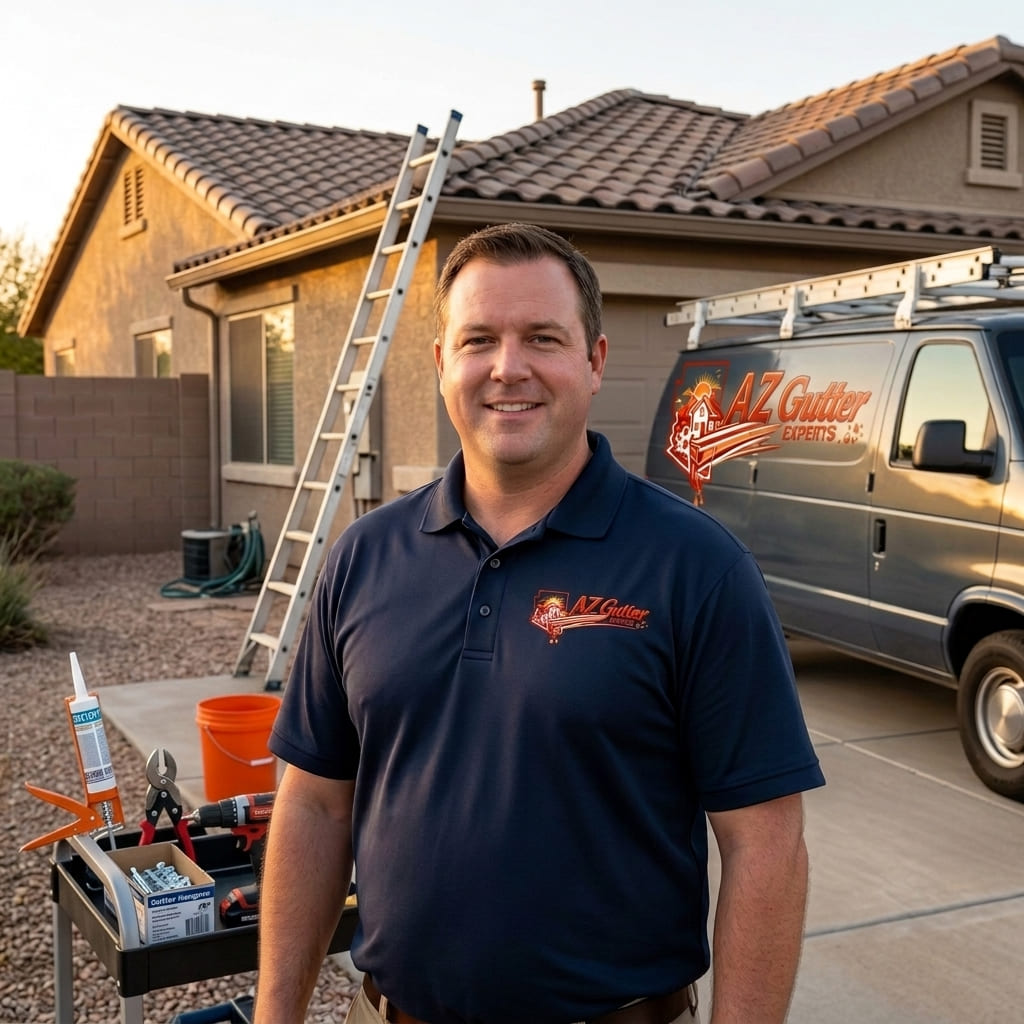
Your local gutter company in Laveen.
The complaints that bring us out to Laveen are usually not about water. They are about cracks. A hairline opening above a door frame that gets a little longer each summer. An interior door that binds in August and swings freely by February. A patio slab separating from the house along one edge. Homeowners describe this as the house settling, and builders get blamed for it, and quite often the actual driver is a downspout at one corner putting several thousand gallons a year into ground that changes size depending on how wet it is.
AZ Gutter Pros covers 85339 — Laveen Village and the older farm parcels, the newer building at Rogers Ranch, Cheatham Farms and Laveen Meadows, and the streets running out toward Dobbins and the river.
This is old irrigated farmland, and the alluvial soils under it carry a meaningful clay fraction. Clay of that kind is expansive: the mineral structure takes water in between its layers and the volume increases, then gives it up as the ground dries and the volume falls again. Over a whole lot that movement is uniform and nothing much happens. The damage comes from doing it unevenly — one part of a foundation perimeter kept wet while the rest bakes — because the slab then has to bridge ground that is at two different heights, and slabs are not good at that.
Which reframes what a gutter is doing here. In most of the Valley the argument for drainage is straightforward water damage: keep it off the stucco, out of the entry, away from the wood. In Laveen the more expensive mechanism is dimensional, and the objective is not simply dryness but evenness — a perimeter with roughly the same moisture content all the way round, and no single point taking a concentrated roof load storm after storm. That objective changes where a leader is allowed to end, and it makes discharge distance a structural number rather than a matter of tidiness.
Neighborhoods & areas we cover in Laveen
Every gutter service, available in Laveen.
Seamless Gutters in Laveen, AZ
Full coverage matters more here than profile size. An unguttered elevation soaks a single strip of perimeter in every storm while the remaining sides stay dry, and that imbalance is what the slab ends up bridging.
Gutter Cleaning in Laveen, AZ
Dust off the surrounding farm ground plus litter from the older windbreak plantings. Keeping a run pitched and flowing is what prevents a blockage from concentrating every overflow onto one patch of ground.
Gutter Guards in Laveen, AZ
Worth it on the older parcels with mature trees along the field lines. On the newer estates with little canopy overhead, the load is fine dust and a guard adds less than a proper clearing schedule does.
Read more about gutter guards in Laveen →Downspout Installation & Repair in Laveen, AZ
The part that matters most in Laveen. Extensions and buried leaders carrying water well past the footing, and never a splash block dropping a concentrated load at one corner of the slab.
Not sure which you need in Laveen? Call (602) 536-0941 and we’ll point you the right way.
The advantage of hiring locally in Laveen.
Local, so we arrive fast
Laveen sits inside the core coverage area, which means quick scheduling — often within the same week for repairs and cleanings.
We know the local weather
We size and pitch systems for how storms actually hit the Southwest Valley below South Mountain, not a mild national average that overflows in July.
Honest, written pricing
You get a clear written estimate before any work starts. The number we agree on is the number you pay — no surprises.
Clay changes size with moisture, so the damage is movement rather than a leak.
The mechanism is worth understanding because it explains why the symptoms look like a structural fault rather than a drainage one.
Expansive clay swells when it takes on moisture and shrinks as it dries, and the vertical movement across a season can be substantial on soils with a high clay fraction. Now picture a house. The middle of a slab sits over ground that is shaded by the building itself, protected from evaporation, and fairly stable in moisture all year. The perimeter does not: it is exposed to sun, to irrigation, to landscaping, and to whatever your roof delivers. So the edges move and the centre does not, and if one edge moves more than the others the slab is forced into a shape it was not designed to hold. That is what puts a diagonal crack above a door frame, what racks a frame enough to make a door bind in one season and clear in another, and what opens a joint between a patio and the house.
Now add the downspout. A modest roof plane delivers hundreds of gallons in a single decent storm, and a leader with a splash block puts all of it into a couple of square feet of soil right at the footing. Within hours that corner has swelled to its limit while every other stretch of perimeter sits unchanged. Then it dries back over the following weeks. Repeat every monsoon, plus every winter front, for years. The cumulative differential at that one corner is the thing doing the damage, and it is entirely a function of where the water was released.
So the specification in Laveen is about distance and evenness, and there is a second local complication on top of it.
Distance first: get the discharge well beyond the zone of soil that is influencing the footing. Ten feet is the usual minimum quoted and it is a floor rather than a target — further is better where the lot allows, and on a tight side yard the answer is buried pipe carried to the front or rear rather than an extension that stops where the fence starts. Evenness second: every elevation should be guttered, because a bare roof edge is a line source dumping into one strip of ground while the guttered sides stay dry, and that is the same differential problem in a wider form. And consistency through the year matters as well, which is why a run that overflows at one blocked outlet all summer is worse here than the same blockage would be on a gravel site in Cave Creek.
The complication is flood irrigation. A good number of the older Laveen parcels hold irrigation rights and are deliberately graded as shallow basins with berms so the lot can be flooded to a depth on a schedule. That yard is engineered to hold water on purpose, and the standard instruction to grade everything away from the house collides with it head-on. On an irrigated lot we work with the basin rather than against it: discharge placed so roof water joins the irrigation regime instead of adding an out-of-season soaking at one spot, and the leader routed clear of the berm line. Ask us before anyone regrades an irrigated yard — it is easy to destroy a working system by accident. And the honest limit: if your slab has already moved, gutters and extensions stop it getting worse but they will not put it back. Assessing existing movement is a structural engineer’s job, and where we see enough of it we will say so rather than let you believe drainage alone is the whole answer.
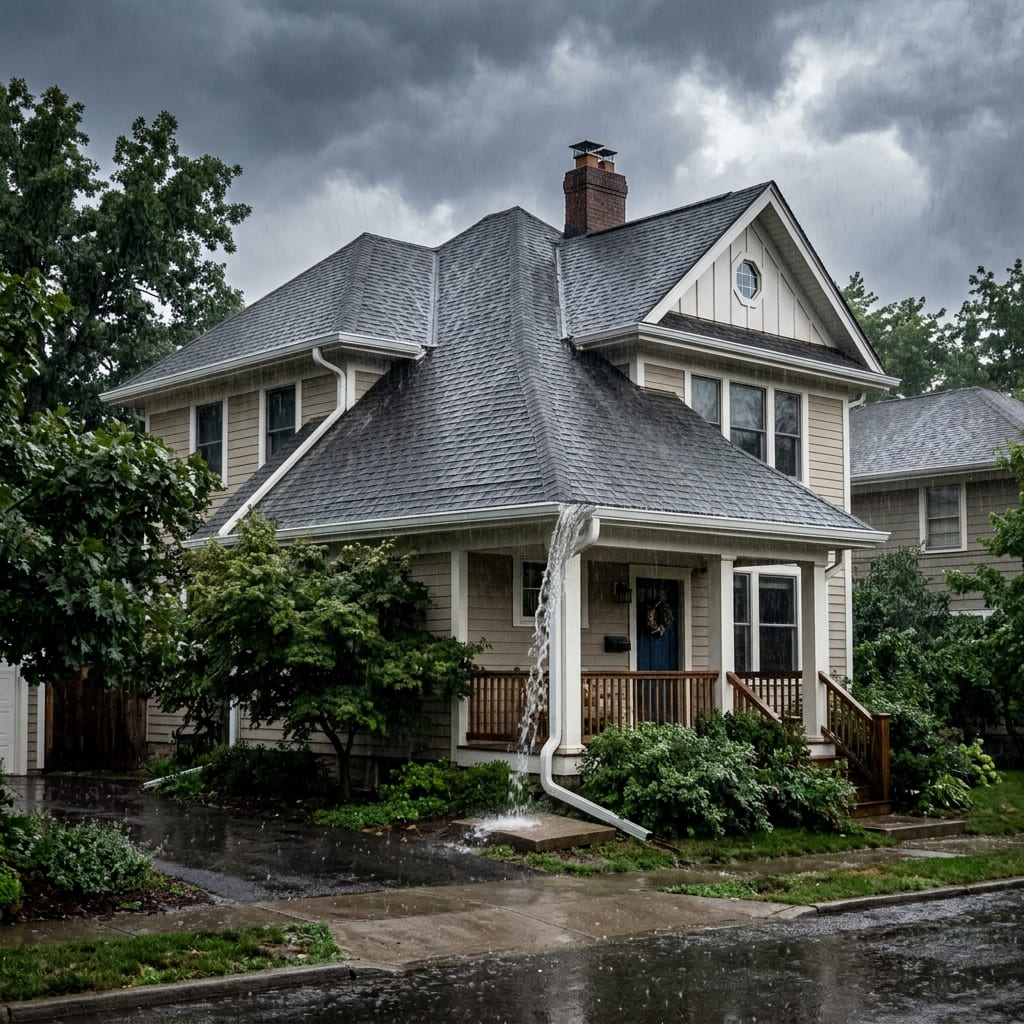
Good to know before you call in Laveen.
My Laveen house has cracks above the doors. Could that be a gutter problem?
It genuinely can be, and it is worth ruling in or out before you spend money elsewhere. The soils under this old farm ground carry a clay fraction that swells when it takes on moisture and shrinks when it dries. A downspout emptying at one corner holds that patch of perimeter wet through each storm while the remainder of the house bakes dry, so one part of the foundation edge sits higher than the others and the slab has to bridge the difference — which shows up as diagonal cracking at door and window corners and as doors that bind seasonally. Moving the discharge well away is cheap and it stops the cycle. It does not undo movement that has already happened.
How far from the house should a downspout discharge in Laveen?
Ten feet is the minimum worth accepting and it should be read as a floor rather than a goal. The reason is that the soil influencing your footing extends outward from it, so releasing water at four or five feet is still releasing it into ground that is holding your slab up. Where the lot gives you room, further is better. Where a side yard is too narrow for an extension, the right answer is usually a buried solid line carried to the front or the back of the property. What we will not do here is fit a splash block and call it finished, because on this ground that is the arrangement that causes the problem.
My lot is flood irrigated. Does that change the drainage advice?
Considerably, and it is worth saying before anyone starts moving soil. An irrigated parcel is graded as a shallow basin with berms so it can be flooded to a set depth on a schedule, which means the yard is designed to hold water — the exact opposite of the standard advice to slope everything away from the building. Regrading such a lot to shed water usually breaks the irrigation and can cost you the practical benefit of a right you are still paying for. We work with the existing basin instead: discharge placed so roof water joins the irrigation pattern rather than soaking one spot out of season, and leaders routed clear of the berms.
Should every elevation of the house be guttered, or just the front?
On this soil, every elevation, and the reason is evenness rather than completeness for its own sake. An unguttered roof edge acts as a line source: every storm lays a concentrated strip of water down the full length of one elevation, leaving that stretch of perimeter saturated while the guttered sides remain comparatively dry. That is the same differential-movement problem that a badly placed downspout causes, just spread over a longer front. Partial guttering is a reasonable compromise on gravel ground elsewhere in the Valley. Here it builds in the imbalance you are trying to avoid.
Which areas around Laveen do you cover?
All of Laveen (85339) — the Village and the older farm parcels, plus Rogers Ranch, Cheatham Farms, Laveen Meadows and the streets out toward Dobbins — along with south Phoenix, Tolleson, Avondale and across toward Goodyear. All of that falls inside our standing Southwest Valley run, which keeps booking quick and leaves ordinary jobs free of any travel charge. On acreage down toward the river, tell us the address and we will check before scheduling.
Serving Laveen and surrounding areas.
Proudly covering Laveen (85339) and nearby Phoenix, Tolleson, Avondale, South Mountain, Goodyear — plus much of the Southwest Valley below South Mountain. Not sure if you’re in range? Just call and ask.