
Gutter Installation & Repair in Black Canyon City, AZ
A valley dumping half a roof onto six feet of gutter will overflow at any size you fit. On an owner-built roofline the fix is a diverter and an outlet, not a bigger trough.
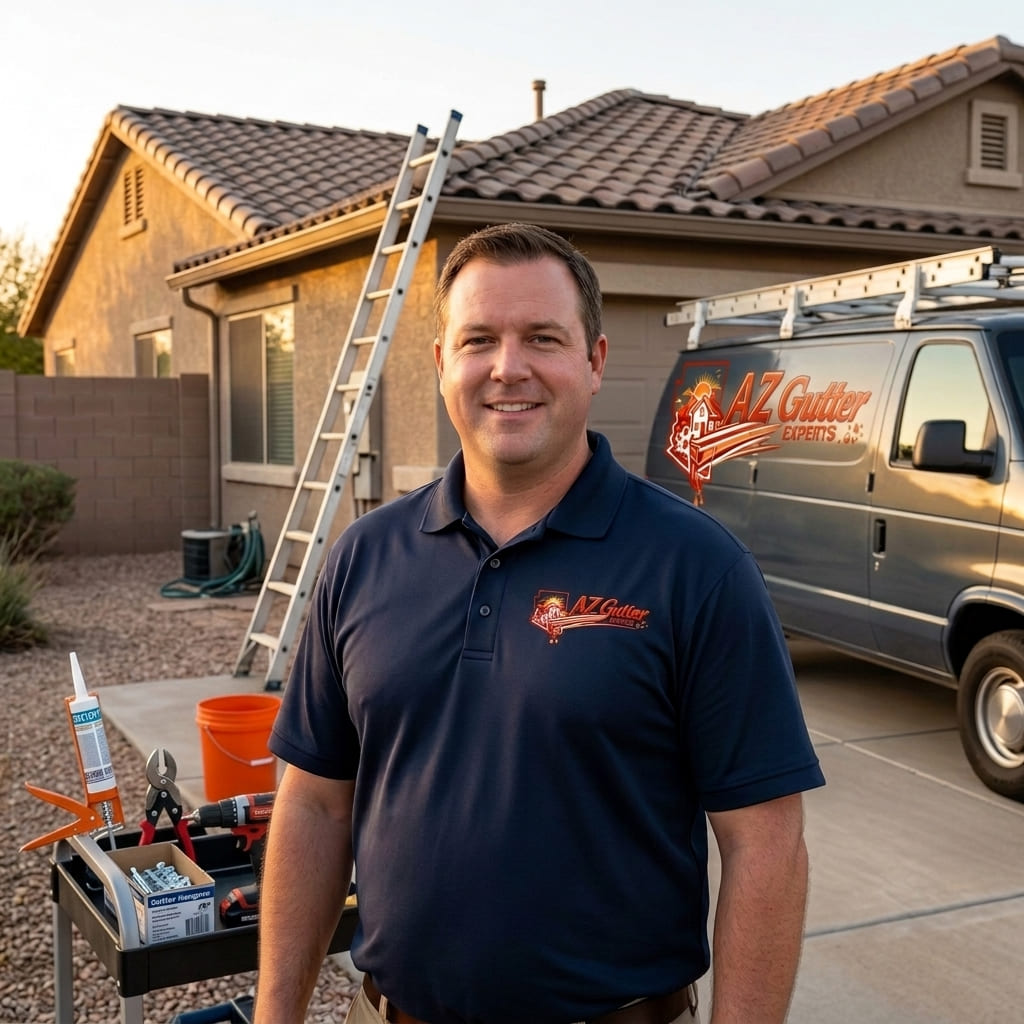
Your local gutter company in Black Canyon City.
Black Canyon City is unincorporated. There is no town government, and a large share of the housing along the Agua Fria and up toward Rock Springs was owner-built, or has grown by steady addition across forty or fifty years — a core structure, then a carport that got enclosed, then a room off the back, then a porch that acquired a roof, then a shop attached down one side. Each of those was a sensible decision on its own. Collectively they produce a roofline that nobody ever designed as a whole, and that is where the water problems in this community actually live.
AZ Gutter Pros covers 85324 — the parcels lining the river corridor and the freeway frontage, the Rock Springs area, Maggie Mine Road, and the hillside lots above them.
The point worth grasping is that on a house like this the trough is rarely the faulty component. Water arrives at the gutter having already been concentrated by the geometry above it, and the geometry above it was assembled in stages. Two roof planes that were never meant to meet now form a valley. An upper roof discharges straight onto a lower one. A lower addition runs into the wall of the taller original. Every one of those junctions gathers a large tributary area and delivers it to a small piece of gutter, and no amount of capacity in that piece of gutter changes the rate at which it arrives.
So the first thing we do on a house here is stand back and work out which roof is feeding which, before measuring anything. It usually explains the whole complaint. The overflow that only happens at the corner by the back door, the stripe of eroded coating down one plane of the lower roof, the stain on the ceiling inside a room that was added in the nineties — these are junction problems with junction solutions, and treating them as gutter-sizing problems is how people spend money twice.
Neighborhoods & areas we cover in Black Canyon City
Every gutter service, available in Black Canyon City.
Seamless Gutters in Black Canyon City, AZ
Formed to fit rooflines that do not match — different pitches, eave heights and materials meeting at angles nobody planned — which takes more measuring and more transitions than a tract house ever does.
Gutter Cleaning in Black Canyon City, AZ
Junction houses trap debris where planes meet, so valleys and the ends of wall lines matter as much as the runs. Those are the points that block first and the ones that do damage when they do.
Gutter Guards in Black Canyon City, AZ
Selectively useful, and a poor idea directly under a live valley — mesh across a valley discharge blinds at the exact spot carrying the most water. Better fitted along the open runs and left off the concentration points.
Downspout Installation & Repair in Black Canyon City, AZ
The real fix for most of what goes wrong here: an oversized outlet placed directly under the point of concentration, with a valley diverter above it so the flow enters the trough instead of jumping it.
Not sure which you need in Black Canyon City? Call (602) 536-0941 and we’ll point you the right way.
The advantage of hiring locally in Black Canyon City.
Local, so we arrive fast
Black Canyon City sits inside the core coverage area, which means quick scheduling — often within the same week for repairs and cleanings.
We know the local weather
We size and pitch systems for how storms actually hit the unincorporated canyon country along I-17, not a mild national average that overflows in July.
Honest, written pricing
You get a clear written estimate before any work starts. The number we agree on is the number you pay — no surprises.
The house grew in stages, and the water gets in where the stages meet.
Three junction failures account for most of what we are called out to in this community.
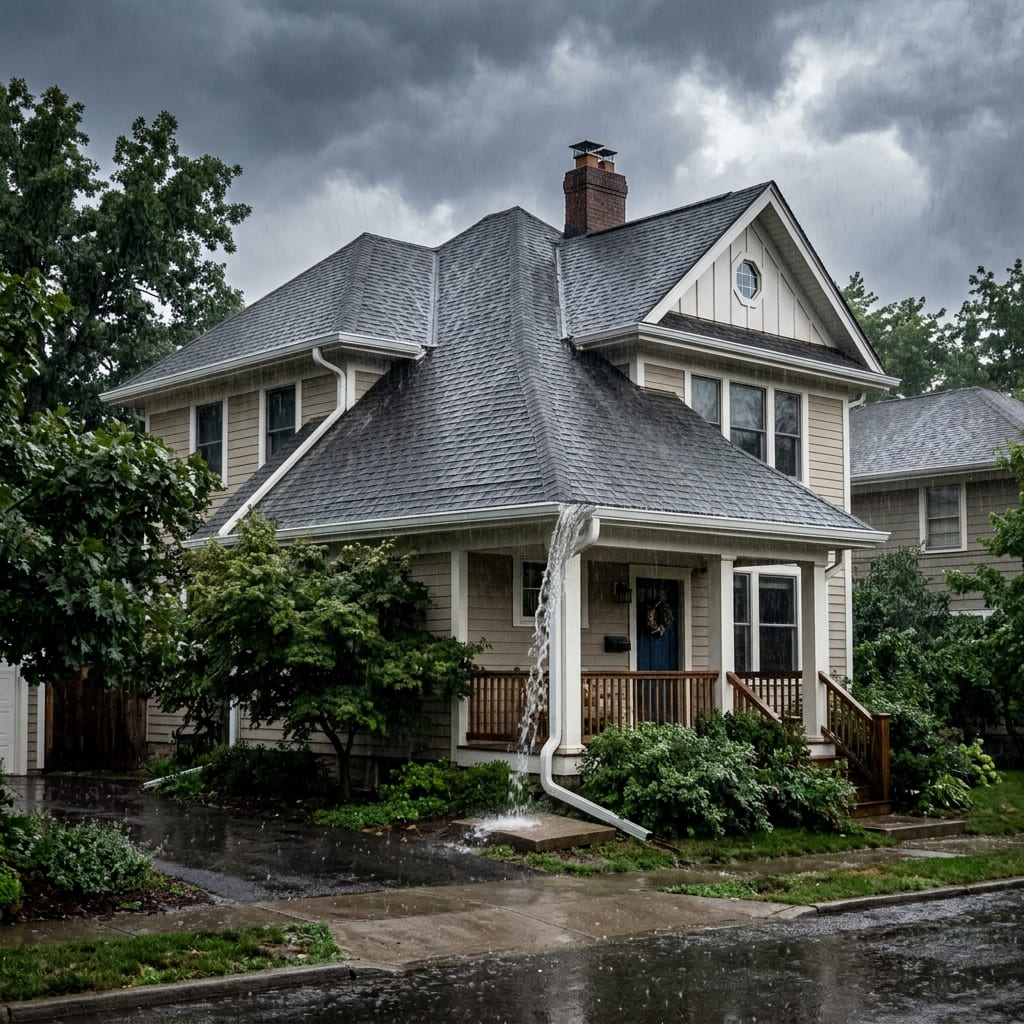
The first is the concentrating valley. Where two roof planes meet they form a channel, and that channel gathers everything falling on both planes and delivers it to a single point at the eave. On a designed roof somebody thought about where that point lands. On a roofline that grew in stages it very often lands over a short run — six or eight feet of gutter above a back door or a window — and that short run now has to pass a flow that the whole rest of the system never sees. It overflows in every serious storm and it looks like a blocked or undersized gutter, so people clean it, then replace it a size up, and it overflows again. What it needs is a diverter at the valley to spread the discharge along the trough, and an outlet placed directly beneath the point of impact and sized for the tributary area actually feeding it rather than for the length of gutter it happens to sit in.
The second is roof onto roof. An upper roof with no gutter at its eave discharges its entire area onto the lower roof below, in a concentrated band. The lower roof then has to carry its own rainfall plus all of that, and its gutter — sized for the lower roof — is overwhelmed. You can usually see the band from the ground as a stripe where the coating or the granule surface has been worn away in a line. Guttering the upper eave and taking a leader down to the lower gutter, or past it, fixes both problems at once.
The third is the roof-to-wall junction, and it is the one that does real damage while staying invisible.
Where a lower addition roof runs into the wall of the taller original structure, water travelling down that wall and along that intersection has to be steered out onto the roof and into the gutter. That is what step flashing does along the length of the join, and it is what a kickout does at the bottom end of it — a small piece of bent metal at the very base of the wall line that kicks the accumulated flow out into the trough instead of letting it continue straight down behind the cladding. The kickout is the single most commonly missing detail in self-built and added-to work anywhere, and it is missing on a great many houses here. When it is absent, every storm sends water into the wall cavity at that corner. Nothing appears outside. The stucco looks fine, the gutter looks fine, and the damage accumulates in the framing behind the wall for years until it shows as a soft patch, a stain inside, or a window that has dropped.
Here is the limit, and it matters because it decides who you should be calling. We can fit the diverter, size and place the outlet, rehang or reroute the trough, and gutter an upper eave that never had one — that resolves the first two failures completely. We cannot install step flashing or a kickout, because doing so means lifting the roof covering at the wall line, and that is roofing work with a roofer’s liability attached. What we will do is tell you plainly if we see the detail missing, show you where it is, and say what it is doing, so that it gets to the right trade rather than being papered over with a bigger gutter. If somebody has offered to solve a roof-to-wall problem for you with sealant from the outside, get a second opinion.
Good to know before you call in Black Canyon City.
One corner of my gutter overflows in every storm and the rest is fine. Why?
Almost certainly a valley is discharging there. Where two roof planes meet they form a channel that collects everything falling on both of them and delivers it to one point at the eave, and on a house that was extended over the years that point frequently lands above a short length of gutter that was never meant to carry it. The flow arrives faster than that section can pass it, so it jumps the front lip. Fitting a larger trough does not help because the constraint is the rate of arrival, not the volume the gutter holds. The answer is a diverter at the valley to spread the discharge, plus an outlet directly below the impact point sized for the roof area actually feeding it.
What is a kickout flashing and why does it matter here?
It is a small bent piece of metal at the bottom end of a roof-to-wall intersection, and its job is to throw the water running down that join outward into the gutter rather than letting it carry on down behind the cladding. It matters enormously in this community because so many houses gained rooms and enclosed carports over the decades, which creates exactly those junctions, and the kickout is the detail most often left out of work done without an inspection. When it is missing, water enters the wall at that corner in every storm with nothing visible outside — no drip, no stain, no mark on the stucco — while the framing behind takes it year after year.
Can you fix a roof-to-wall junction that is leaking into the wall?
Not the flashing itself, and that is worth being straight about. Correcting step flashing or adding a kickout means lifting the roof covering along the wall line, which is roofing work carrying a roofer’s liability, and it is not something we will improvise around. What we can do is identify it, show you exactly where the water is entering and what the missing detail is, and handle everything on our side of the line — guttering, outlet placement, diverters and discharge — so that when the roofer has finished the junction, the water that now reaches the gutter is properly dealt with. If anyone offers to fix a junction like this by running sealant along it from outside, that is a delay rather than a repair.
My upper roof drains straight onto the lower one. Is that a problem?
It is, in two ways at once, and it is easy to fix. The lower roof ends up carrying its own rainfall plus the entire area of the roof above it, arriving in a concentrated band rather than spread across the plane — so the lower gutter, which was sized for the lower roof, is overwhelmed in any real storm. Meanwhile the band itself wears the roof surface along a stripe you can usually pick out from the ground once you know to look. Putting a gutter on the upper eave and running a leader down into the lower gutter, or past it to the ground, deals with both. It is one of the cheapest genuinely worthwhile jobs on a stepped roofline.
Will you genuinely drive out to Black Canyon City?
We do, and this stretch of the I-17 corridor is scheduled work rather than an exception — taking in Rock Springs, the river corridor, Maggie Mine Road and the hillside lots, along with New River, Anthem and up toward Cordes Lakes. Being unincorporated, addresses out here can be vague and some access is unpaved, so describe the approach when you book. Travel is quoted as its own visible line before you agree to anything, and on a roofline assembled in stages it pays for us to see the entire property, not merely the run you called about.
Serving Black Canyon City and surrounding areas.
Proudly covering Black Canyon City (85324) and nearby New River, Anthem, Bumble Bee, Cordes Lakes, Black Canyon — plus much of the unincorporated canyon country along I-17. Not sure if you’re in range? Just call and ask.